
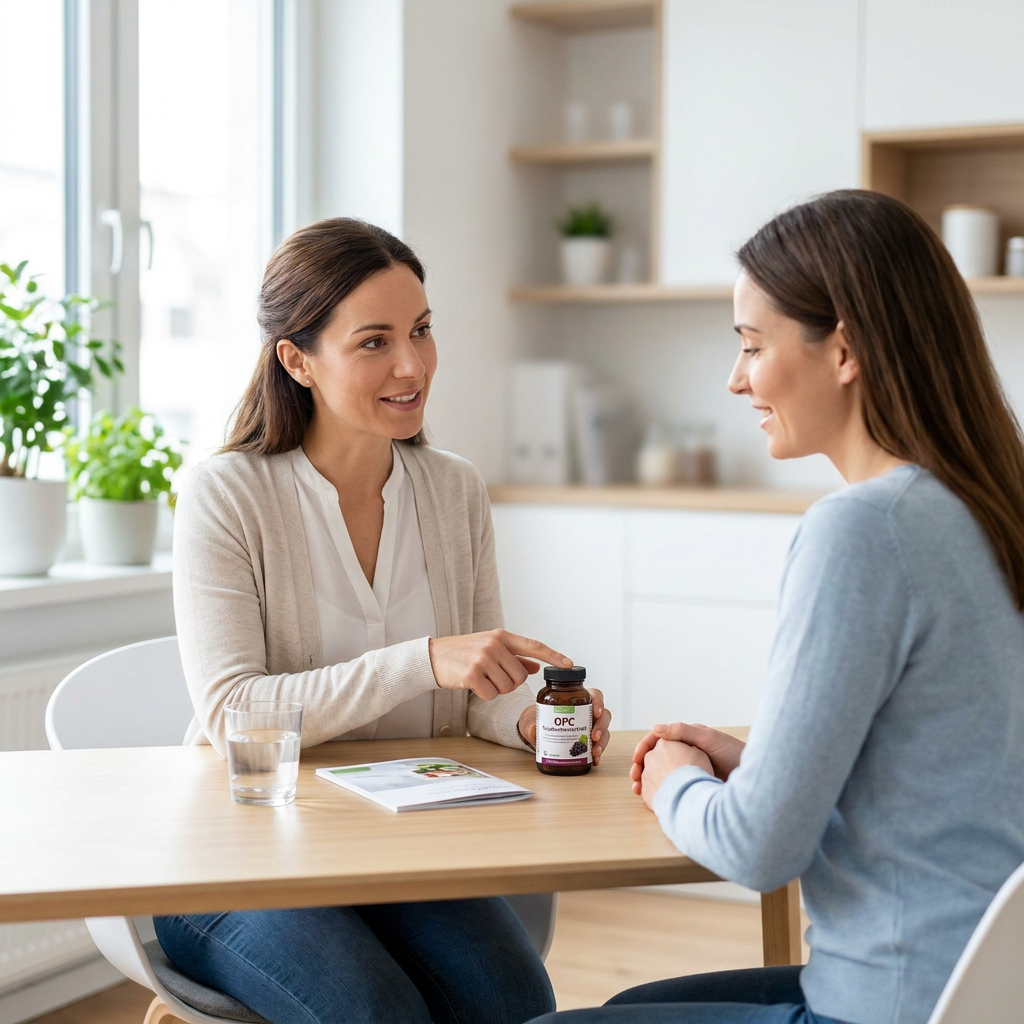
OPC grape seed extract has become one of the most popular dietary supplements in recent years. Oligomeric proanthocyanidins, or OPC for short, are secondary plant compounds with antioxidant properties. However, with the abundance of products on the market, many questions arise: How much OPC should you take daily? How do you recognize high-quality grape seed extract? In this comprehensive guide, you’ll learn everything important about the correct dosage and the crucial quality characteristics of OPC.
What is OPC and how does it work in the body?
Oligomeric proanthocyanidins belong to the group of flavonoids and polyphenols. These bioactive plant compounds are found primarily in grape seeds, but also in pine bark, apples, and various berries. OPC is characterized by a high antioxidant capacity.
In the body, OPC can help neutralize free radicals that can cause oxidative stress. Laboratory studies have shown potential effects on collagen formation, vascular health, and inflammatory processes. The bioavailability of OPC varies depending on the formulation and individual factors.
The correct OPC dosage: What do experts recommend?
The dosage of OPC depends on various factors, including your body weight, your health condition, and your individual goal. There are no official recommendations from health authorities, but scientific studies and empirical values provide helpful guidelines.
Standard dosage for adults
As a general guideline, a daily intake of 100 to 300 mg OPC is recommended for an average adult. Many experts recommend a dosage of about 1 to 2 mg OPC per kilogram of body weight. This means:
With a body weight of 70 kg, that would be about 70 to 140 mg OPC per day. With a body weight of 80 kg, accordingly 80 to 160 mg daily. This amount is used in many studies and is considered well-tolerated.
Higher dosages for special applications
In certain situations, higher dosages are also investigated in studies. For intense physical stress or targeted support, 200 to 400 mg daily are sometimes used. However, you should ideally discuss such higher dosages with a doctor.
Intake recommendations for optimal absorption
Taking OPC can ideally be done about 30 to 60 minutes before or after meals. On an empty stomach, your body may be able to absorb the OPC better. If you have a sensitive stomach, you can also take OPC with meals.
Simultaneous intake with protein-rich foods such as dairy products could affect absorption. If taking vitamin C at the same time, you can maintain about 30 minutes spacing, although both substances can complement each other in their antioxidant effect.
Quality characteristics: How do you recognize high-quality OPC?
The market for OPC supplements is confusing, and quality varies considerably. To ensure that you receive an effective and safe product, you should pay attention to the following quality characteristics.
The OPC content: Pay attention to precise information
The most important quality characteristic is the actual OPC content per capsule or serving. Many manufacturers only state the total content of grape seed extract, not the specific OPC proportion. A reputable manufacturer declares both clearly and distinctly.
High-quality products often contain 40 to 95% OPC in relation to the grape seed extract. This means: If a capsule contains 200 mg of grape seed extract and it consists of 95% OPC, you receive 190 mg of pure OPC per capsule. Make sure that these values are transparently stated on the label.
Manufacturing process and extraction method
The quality of OPC depends significantly on the manufacturing process. High-quality extracts are obtained through gentle extraction processes that preserve the valuable active ingredients. Alcohol-water extraction or water extraction are considered common methods.
Reputable manufacturers provide information about their extraction methods, either on the packaging or on their website. Gentle processes without aggressive solvents are preferable.
Purity and additives
A high-quality OPC supplement should be as pure as possible and contain few to no additives. Check the ingredient list critically: Usually only the capsule itself and possibly a separating agent are necessary.
Avoid products with artificial colorings, flavors, or preservatives. The shorter the ingredient list, the better. Also make sure that the product is free of allergens if you have corresponding intolerances.
Laboratory tests and certificates
Trustworthy manufacturers have their products regularly tested by independent laboratories. These analyses check the actual OPC content, purity, and absence of contaminants such as heavy metals, pesticides, or microbial contamination.
Look for quality seals and certificates such as ISO standards, GMP (Good Manufacturing Practice), or comparable standards. Reputable suppliers provide analysis certificates upon request or publish them on their website. This creates transparency and trust.
Origin of the grape seeds
The origin of the raw materials also plays a role. Grape seeds from organic cultivation are free of synthetic pesticides and other chemical residues. Ideally, the grapes come from controlled cultivation where strict quality controls apply.
Some manufacturers use grape seeds from wine production, which represents a sustainable use of by-products. Information about the origin can usually be found on the product packaging or the manufacturer’s website.
Avoid common mistakes when buying OPC
Confusion between extract amount and OPC content
A common mistake is confusing the amount of grape seed extract with the actual OPC content. If a product contains 500 mg of grape seed extract, this doesn’t automatically mean 500 mg of OPC. With an extract containing 40% OPC, it would only be 200 mg of pure OPC.
Always calculate: Extract amount × OPC percentage = actual OPC content. Only this way can you really compare products and find the best price-performance ratio.
Choosing too low a dosage
Some products contain only very small amounts of OPC per capsule, so you would have to take several capsules daily to reach a recommended dose. This makes intake cumbersome and often more expensive. Choose a product where one or two capsules daily are sufficient to reach the desired daily dose.
Buying overpriced products
Price alone is not a quality characteristic. Some manufacturers charge high prices for marketing and packaging, not for the actual product quality. Compare the price per 100 mg of pure OPC to find out which product really offers good value for money.
Properly storing OPC supplements
To ensure your OPC supplement maintains its effectiveness, you should store it properly. Keep the product in a cool, dry, and dark place. Direct sunlight and high temperatures can affect the sensitive plant compounds.
Close the packaging carefully after each removal to keep moisture out. With proper storage, OPC remains stable at least until the printed best-before date.
Possible side effects and contraindications
OPC is generally considered well-tolerated. However, you should note a few points. In rare cases, with very high dosages, mild side effects such as headaches, dizziness, or stomach discomfort may occur. These usually disappear when you reduce the dose.
If you are taking blood-thinning medications, you should consult with your doctor before taking OPC, as OPC may possibly affect blood clotting. Also during pregnancy and breastfeeding, you should as a precaution avoid OPC or discuss intake with medical professionals, as there is not yet sufficient data available on this.
Conclusion: With the right dosage and quality, you can benefit optimally from OPC
OPC grape seed extract is a popular dietary supplement with interesting health properties. You can achieve a good effect if you pay attention to the correct dosage and high quality. As a guideline, a daily intake of 100 to 300 mg OPC applies, where you can orient yourself to about 1 to 2 mg per kilogram of body weight.
When selecting a product, you should pay attention to a declared OPC content, gentle manufacturing processes, purity without unnecessary additives, and independent laboratory testing. Compare different products not only by price, but calculate the actual OPC content and the price-performance ratio.
With this information, you are well-equipped to find a high-quality OPC supplement that meets your individual needs. Take your time with product selection. If you have uncertainties or special health questions, don’t hesitate to consult a doctor or nutritionist.
Dieser Ratgeber dient ausschließlich zu Informationszwecken und ersetzt keine medizinische Beratung oder Diagnose. Bei anhaltenden Beschwerden konsultieren Sie bitte einen Arzt. Nahrungsergänzungsmittel und Heilpflanzen sollten nicht ohne Rücksprache mit einem Therapeuten eingenommen werden.