
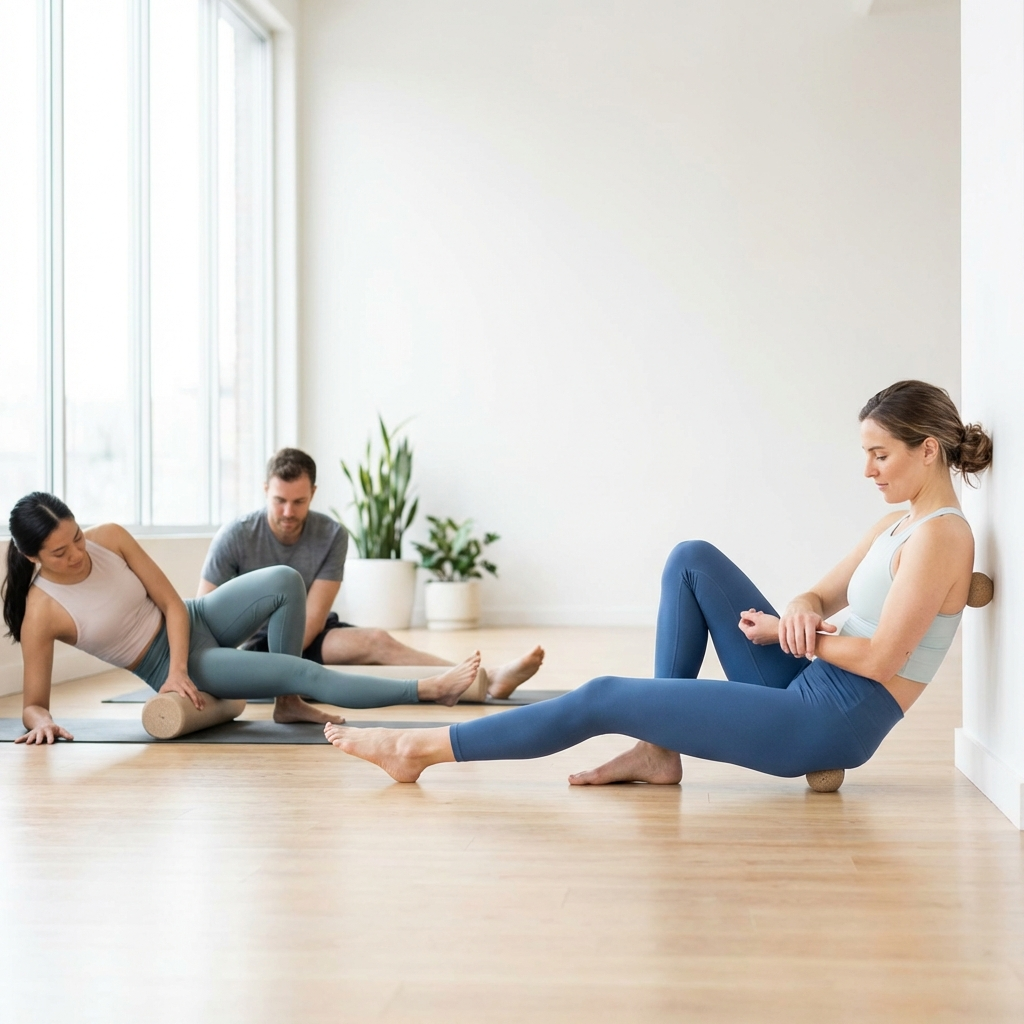
Have you ever heard of fascia yoga? This special form of yoga differs fundamentally from classical yoga, because here it’s not primarily about intensive stretching, but about specifically releasing adhesions in the fascial tissue. Fascia runs through your entire body like a three-dimensional network and can lose its gliding ability due to lack of movement, stress, or one-sided strain. The result: pain, tension, and restricted mobility. Fascia yoga addresses exactly this and offers you a gentle but effective way to make your connective tissue supple again.
What is fascia and why does it lose its gliding ability?
Fascia are collagen-containing connective tissue structures that envelop every muscle, every organ, and even individual muscle fibers. They give your body shape and stability, while simultaneously enabling smooth movements. You can imagine fascia as a kind of elastic network that connects all structures with each other and transfers forces in the body.
Problems arise when the fascia loses its natural gliding ability. This can have various causes: sitting for long periods in the office, one-sided movement patterns, too little movement in general, or even chronic stress can lead to the fascial tissue becoming less elastic and densifying. The normally well-sliding layers can lose their optimal function. You feel the result as stiffness, restricted mobility, or even pain.
The difference between classical yoga and fascia yoga
In classical yoga, the focus is often on stretching the muscles and achieving certain positions. The exercises are often performed with strength and a certain intensity. Fascia yoga pursues a different approach: here you work with gentle, bouncing movements, long holding times, and conscious micro-movements.
While traditional yoga mainly addresses the muscles, fascia yoga targets the connective tissue directly. The exercises are less static and include more dynamic, oscillating elements. You will notice that you don’t stretch to your pain threshold, but stay at a pleasant intensity and experiment with small movements.
The principles of fascia yoga
Fascia yoga is based on several principles that are founded on current findings in fascia research. The first principle is slow, conscious movement. Fascia reacts differently than muscles and needs more time – that’s why you hold positions longer than in classical yoga and give the tissue time to adapt and relax.
The second principle is bouncing, rocking movements. These micro-impulses stimulate the fascia and can promote the fluid supply of the tissue. You can imagine this like wringing out a sponge: the movement mobilizes fluid and stimulates metabolism in the tissue.
Another important element is the variety of movement directions. Unlike classical yoga, where linear movements often dominate, in fascia yoga you work with rotations, spiral movements, and unusual angles. This way you reach the fascia from different directions and address different fascial lines.
The most important techniques in fascia yoga
Dynamic stretching with bouncing movements
Instead of remaining statically in a stretching position, in fascia yoga you move gently in and out of the stretch. These bouncing movements should be small and controlled, as if you were finding a rhythm. This technique can not only activate the fascia, but also improve blood circulation and lymph flow in the tissue.
Try it, for example, in a forward bend: instead of just hanging forward, you bounce gently up and down, explore small side bends, or circle minimally with your upper body. These variations address different fascial lines.
Long holding times at medium intensity
When you hold a position in fascia yoga, you stay in the stretch for about two to three minutes. This may feel long at first, but allows for a deeper effect on the connective tissue. It’s important that you only reach about 60 to 70 percent of your maximum stretching ability. It should feel pleasantly intense, but never painful.
While you hold the position, you can observe how your body gradually yields. Often you notice that after a minute you can suddenly sink a bit deeper into the stretch – that’s the sign that your fascia is relaxing and letting go.
Self-massage and pressure
Many fascia yoga sessions integrate tools such as balls or rollers. You can apply targeted pressure to tense areas and massage them. The combination of pressure and movement intensifies the effect and can help release tension.
It’s particularly effective when you lie on a ball and then perform small movements. The pressure of the ball massages the tissue while the movement mobilizes the fascia in different directions.
Typical fascia yoga exercises for different body areas
For the back: The swinging cat
Come into a quadruped position and begin to move your spine in a wave-like motion. Unlike the classic cat-cow exercise, you make the movements more fluid and let gravity play along. Let your belly swing, move sideways, and explore circular movements with your pelvis. This exercise mobilizes the fascia along the entire back fascia.
For the legs: The bouncing downward-facing dog
In downward-facing dog, you can alternately let your heels sink to the floor while bouncing gently in your knees. Vary the position of your feet, turn your heels inward, then outward, and explore where you feel tension. This dynamic variation reaches the fascial lines on the back of the legs more effectively than static holding.
For shoulders and neck: Arm circles with variations
Extend your arms to the sides and circle them at different speeds and sizes. Vary your hand position, bend and stretch your elbows slightly, and feel how the movement continues into your neck and upper back. This exercise can release tension in the shoulder-neck area, where many people have problems due to computer work.
The right breathing in fascia yoga
Breathing also plays a special role in fascia yoga. Unlike classical yoga, where specific breathing techniques are often prescribed, in fascia yoga you may follow your natural breathing rhythm. What’s important above all is that you continue breathing in a relaxed manner and don’t hold your breath.
Your breath can also serve as an indicator: if you can no longer breathe calmly in a position, the intensity is too high. Your breathing should remain deep, calm, and even. Some practitioners report that with deep exhalations they can sink a bit deeper into the stretch – the fascial tissue relaxes with the exhalation.
How often should you practice fascia yoga?
Fascia are structures that need time to change. At the same time, they respond well to regular stimuli. Ideal are two to three sessions per week of 30 to 60 minutes each. Regularity is important – better twice a week for 30 minutes than once a month for two hours.
After an intensive fascia yoga session, you should give your body at least 24 to 48 hours of recovery time. During this phase, positive adaptations in the tissue can develop. Too frequent training can be counterproductive and lead to overload.
What you should consider after fascia yoga
After a fascia yoga session, it’s especially important to drink enough water. The movements and pressure on the tissue stimulate metabolism. At least half a liter of water directly after practice supports this process and helps balance your fluid levels.
Some people feel a slight muscle soreness or a kind of “pleasant ache” in the tissue the day after fascia yoga. This is normal and shows that something has been set in motion. However, these sensations shouldn’t be too strong – if you have real pain, you went too intensely.
Fascia yoga with existing complaints
Fascia yoga can have a supportive effect with many complaints, from chronic back pain to neck tension to restricted mobility. Especially people who sit a lot or have one-sided movement patterns can benefit from this practice.
However, there are also contraindications: with acute inflammation, fresh injuries, fever, or directly after operations, you shouldn’t practice fascia yoga. Also with osteoporosis, severe cardiovascular diseases, or during pregnancy, you should speak with your doctor beforehand.
If you’re unsure whether fascia yoga is suitable for you, consult medical professionals or a physiotherapist. They can also tell you which areas you should treat particularly carefully and which exercises are best suited for your individual situation.
Fascia yoga at home or in a class?
In principle, you can also practice fascia yoga at home, especially if you already have yoga experience. There are numerous online videos and books on the subject. However, especially at the beginning, it’s helpful to attend a class to properly understand the principles and receive individual corrections.
A qualified fascia yoga teacher can show you how to perform the exercises optimally and work with the right intensity – because both too timidly and too intensely can be less effective.
Conclusion: Fascia yoga as a holistic approach for more mobility
Fascia yoga offers you a gentle but effective way to train your connective tissue and improve your mobility. Unlike classical yoga, it’s not about maximum stretching or achieving perfect positions, but about conscious, bouncing movements and longer holding times at medium intensity.
The principles of fascia yoga are based on current findings in fascia research. Through regular practice, you can not only release acute tension, but also ensure more supple tissue in the long term. The combination of dynamic movements, targeted pressure, and long holding times optimally addresses the fascia.
Whether you suffer from chronic tension, want to improve your mobility, or simply want to do something preventative for your body – fascia yoga is suitable for many people. What’s important is that you practice regularly, listen to your body’s signals, and allow yourself the necessary recovery time. With patience and consistency, you will feel how your body becomes more supple and old movement restrictions can improve.
Try it out and discover how beneficial it can be when tense fascia releases again and your body returns to greater mobility. Your connective tissue will thank you!
Dieser Ratgeber dient ausschließlich zu Informationszwecken und ersetzt keine medizinische Beratung oder Diagnose. Bei anhaltenden Beschwerden konsultieren Sie bitte einen Arzt. Nahrungsergänzungsmittel und Heilpflanzen sollten nicht ohne Rücksprache mit einem Therapeuten eingenommen werden.