
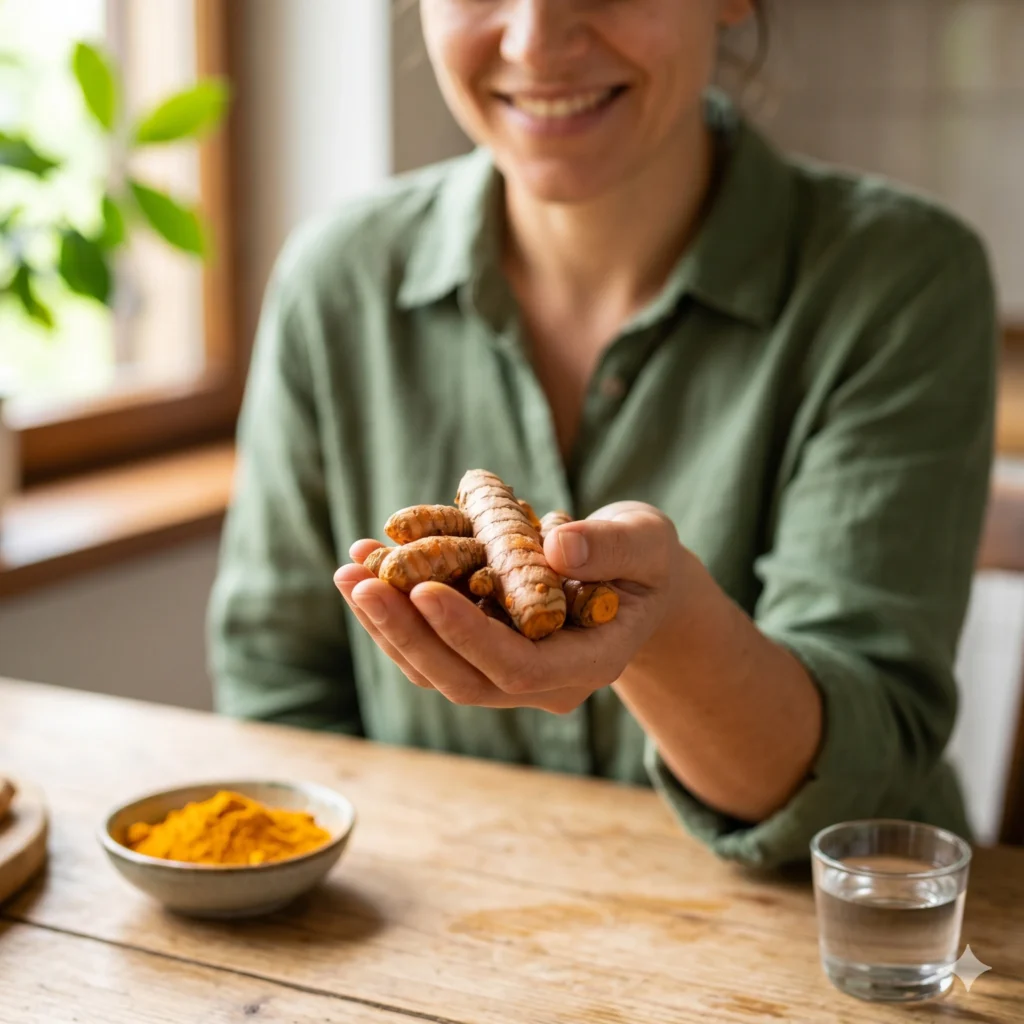
Turmeric is far more than just a spice in Asian cuisine. The golden-yellow root has become one of the most popular dietary supplements in recent years – and for good reason. High-dose turmeric supplements in particular can offer various health benefits. But what’s really behind it? In this article, you’ll learn everything about the effects of high-dose turmeric, proper usage, and what to look for when buying.
What makes turmeric so special?
Turmeric, also called yellow root or turmeric, comes from the ginger family and has been used for thousands of years in traditional Ayurvedic and Chinese medicine. The most important active ingredient in the turmeric root is curcumin, a secondary plant compound with interesting properties.
Curcumin is responsible for the characteristic yellow color of the root and makes up approximately 3-5% of the dried turmeric root. This compound is exactly what is credited with most of the health effects. In high-dose turmeric supplements, the curcumin concentration is significantly higher than in the natural root.
The scientifically studied effects of high-dose turmeric
Anti-inflammatory properties
One of the best-researched effects of curcumin is its anti-inflammatory action. Various studies show that curcumin can influence the activity of various pro-inflammatory enzymes and messenger substances in the body. This effect is particularly interesting for people with chronic inflammatory diseases such as arthritis, inflammatory bowel diseases, or rheumatic complaints.
Some studies have investigated whether the anti-inflammatory effect of high-dose turmeric is comparable to pharmaceutical anti-inflammatory drugs. The data here is promising, although further long-term studies are necessary.
Antioxidant power
Oxidative stress from free radicals is associated with premature aging processes and various diseases. Curcumin shows antioxidant properties in studies and can neutralize free radicals. Additionally, it appears to stimulate the body’s own production of antioxidant enzymes, thus supporting your body’s natural defense mechanisms.
Support for brain function
The research results on the effect of curcumin on the brain are particularly exciting. The active ingredient can cross the blood-brain barrier and exert various effects there. Studies show that curcumin can influence the concentration of the growth factor BDNF (Brain-Derived Neurotrophic Factor), which is important for the formation of new nerve cells.
This could explain why curcumin shows positive effects in supporting cognitive functions in some studies. Research on neurodegenerative diseases such as Alzheimer’s is promising but still in an early stage.
Positive effects on heart health
Your cardiovascular system could also benefit from high-dose turmeric. Curcumin can improve the function of the endothelium – the inner lining of blood vessels – and thus contribute to healthy circulation. It can also help positively influence cholesterol levels and reduce oxidative processes.
Support for joint health
For people with joint complaints, high-dose turmeric is particularly interesting. Several clinical studies have shown that curcumin supplements can relieve pain and stiffness in osteoarthritis and rheumatoid arthritis. The effect is mainly attributed to the anti-inflammatory properties.
Positive effect on digestion
Turmeric stimulates the production of bile acid and thus supports fat digestion. In inflammatory bowel diseases such as ulcerative colitis, studies have shown promising results. High-dose curcumin can help reduce inflammation in the digestive tract and strengthen the intestinal barrier.
The bioavailability problem
As interesting as the effects of curcumin are – there’s one critical catch: The bioavailability of pure curcumin is very low. This means that your body can only actually utilize a very small proportion of the curcumin consumed. The active ingredient is quickly metabolized and excreted again.
This is exactly where high-quality high-dose turmeric supplements come in. They use various technologies to increase bioavailability:
Combination with piperine
Piperine is the active ingredient from black pepper. Studies show that the simultaneous intake of piperine can increase the bioavailability of curcumin by up to 2000%. Many high-dose turmeric supplements therefore contain an addition of piperine or black pepper extract.
Micellar curcumin
With this technology, curcumin is enclosed in tiny, water-soluble particles (micelles). This significantly increases absorption in the intestine – studies speak of significantly higher bioavailability compared to normal curcumin powder.
Liposomal curcumin
Here, curcumin is packaged in fat vesicles (liposomes) that protect it from breakdown and facilitate absorption into cells. This technology can also improve bioavailability.
Special curcumin extracts
There are patented curcumin extracts that are either combined with natural oils from the turmeric root or obtained through special extraction processes and are supposed to enable better absorption.
Proper dosage of high-dose turmeric
The optimal dosage depends on various factors: the supplement used, the bioavailability, and your individual health condition. The following guidelines serve as orientation:
For general health benefits, experts recommend 500-1000 mg of curcumin daily with enhanced bioavailability. For specific applications, such as joint complaints or chronic inflammation, higher dosages may also be useful after consultation with a doctor.
Important: With supplements with improved bioavailability (micellar or liposomal curcumin), you need significantly smaller amounts. Here, as little as 200-500 mg daily can be sufficient, as the body can absorb the active ingredient much better.
It’s best to start with a lower dose and gradually increase it if well tolerated. The intake should ideally be with meals, especially if they are fat-soluble supplements.
What to look for when buying
The market for turmeric supplements is confusing. With these criteria, you’ll find a high-quality product:
Curcumin content and standardization
Make sure that the curcumin content is clearly stated and standardized. High-quality supplements contain at least 95% curcuminoids. Pure turmeric powder capsules contain only about 3-5% curcumin – these are usually less suitable for targeted applications.
Bioavailability technology
The supplement should use one of the above-mentioned technologies to improve bioavailability. Without such measures, the effect is significantly limited.
Quality seals and purity
Reputable manufacturers have their products tested by independent laboratories. Look for quality seals and certificates that confirm testing for pollutants, pesticides, and heavy metals.
Additives
High-quality supplements contain as few additives as possible. Avoid products with unnecessary fillers, artificial colors, or allergenic substances.
Origin and manufacturing
Prefer products with transparent information about the origin of the turmeric root and manufacturing in Germany or Europe according to GMP standards.
Possible side effects and interactions
High-dose turmeric is generally considered well tolerated. Nevertheless, you should note a few points:
At very high doses, gastrointestinal complaints such as nausea, diarrhea, or stomach pain can occasionally occur. These can usually be avoided by gradually increasing the dose and taking the supplement with meals.
Curcumin has blood-thinning properties. If you are already taking blood-thinning medications, you should definitely consult your doctor before taking high-dose turmeric supplements. The same applies before surgeries.
If you have gallstones or bile duct obstructions, you should avoid high-dose turmeric, as it stimulates bile production.
Pregnant and breastfeeding women should only use high-dose supplements after consultation with their doctor, even though normal amounts as a spice are considered safe.
Curcumin can influence the effect of certain medications, such as blood thinners, diabetes medications, or medications for gastric acid reduction. Therefore, inform your doctor about the intake.
High-dose turmeric: capsules, powder, or drops?
High-dose turmeric is available in various forms:
Capsules are the most popular form. They are practical to use, taste-neutral, and offer precise dosing. Especially capsules with improved bioavailability are recommended.
Powder offers flexibility in dosing and can be stirred into drinks or smoothies. However, the intense taste is not to everyone’s liking, and the bioavailability is often lower without additives.
Liquid forms such as micellar or liposomal drops often have good bioavailability and can be taken directly or stirred into liquids.
The choice of form is ultimately a matter of taste. More important is that the supplement ensures good bioavailability and is of high quality.
How long does it take for turmeric to work?
The question of when effects begin cannot be answered in general terms, as this depends on various factors. Initial effects can be noticeable in some people after just a few days.
For significant improvements in chronic complaints such as joint pain, you should take high-dose turmeric regularly for at least 4-8 weeks. The antioxidant and supportive effects unfold over longer periods with continuous intake.
Regular intake is important. Curcumin is excreted relatively quickly by the body, which is why daily intake is necessary to achieve constant levels.
Conclusion: Is high-dose turmeric worth it?
High-dose turmeric is a scientifically well-studied dietary supplement with diverse interesting properties. The anti-inflammatory, antioxidant, and neuroprotective properties of curcumin have been investigated by various studies.
However, the right selection of the supplement is crucial. Without measures to improve bioavailability, a large part of the potential effect can be lost. Therefore, invest in high-quality products with proven enhanced bioavailability – whether through piperine, micellar technology, or liposomal encapsulation.
Start with a moderate dose and increase it as needed. Give your body time to respond to the turmeric and take it regularly over a longer period. If you have existing illnesses or are taking medications, you should definitely consult your doctor before supplementing with high-dose turmeric.
High-dose turmeric can be a sensible addition to a healthy lifestyle – however, it does not replace a balanced diet, sufficient exercise, and a healthy lifestyle. In combination with these pillars of health, high-dose turmeric can support you in promoting your well-being.
Dieser Ratgeber dient ausschließlich zu Informationszwecken und ersetzt keine medizinische Beratung oder Diagnose. Bei anhaltenden Beschwerden konsultieren Sie bitte einen Arzt. Nahrungsergänzungsmittel und Heilpflanzen sollten nicht ohne Rücksprache mit einem Therapeuten eingenommen werden.