
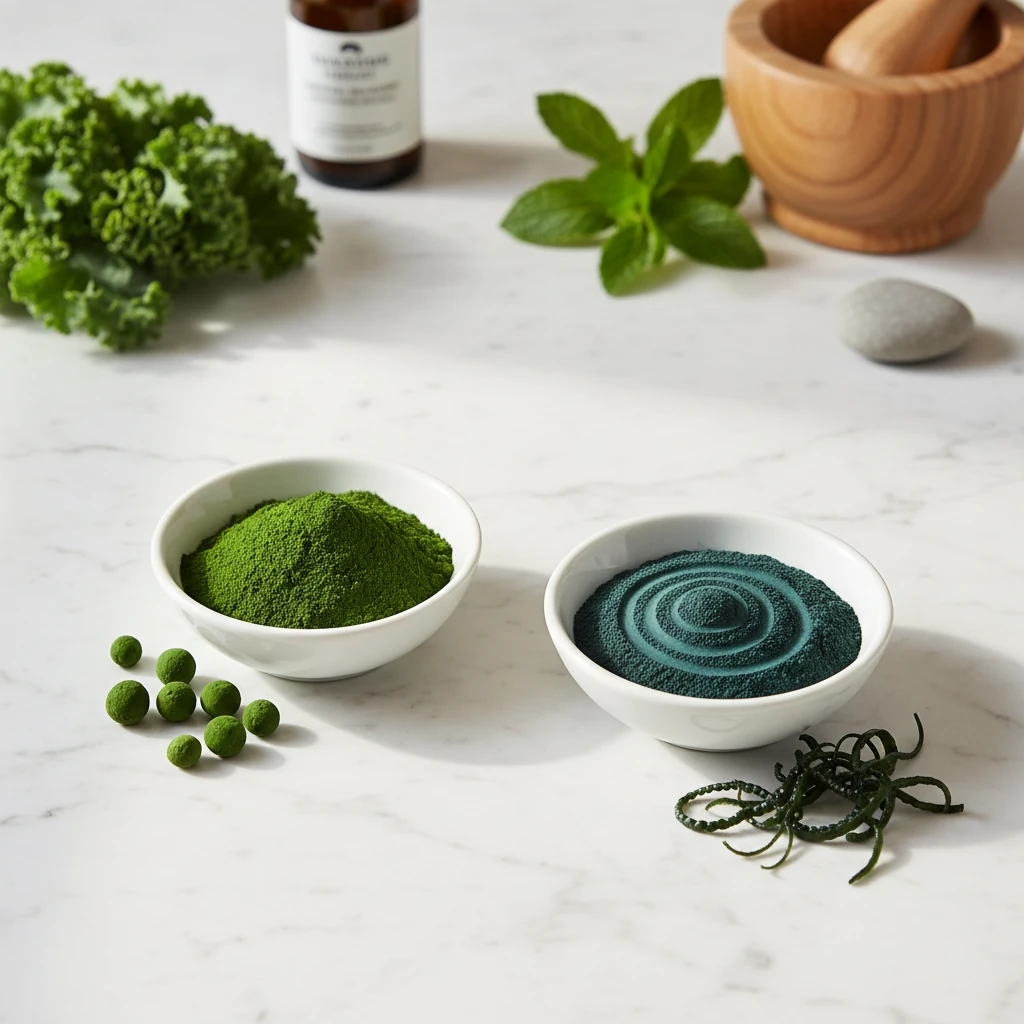
Green superfoods are trending – and two algae lead the popularity scale: Chlorella and Spirulina. Both offer interesting health properties, but which one suits you better? In this article, you’ll learn everything about the differences, similarities, and areas of application of these two algae, so you can make an informed decision.
What are Chlorella and Spirulina?
Before we dive into the comparison, it’s important to understand what we’re actually dealing with. Although both are referred to as “algae,” they differ fundamentally in their biological classification.
Chlorella – the green freshwater algae
Chlorella is a single-celled freshwater algae that belongs to the group of green algae. It’s characterized by its high chlorophyll content – hence its intensely green appearance. Chlorella’s cell wall is particularly robust, which must be considered during processing so that the nutrients become available to the human body.
Spirulina – the blue-green cyanobacterium
Spirulina, on the other hand, is biologically not a true algae at all, but a cyanobacterium – also known as blue-green algae. It grows in a spiral shape (hence the name) and thrives in alkaline waters with high pH levels. Unlike Chlorella, Spirulina has no hard cell wall, making its nutrients more easily digestible.
Nutrient profile in direct comparison
Both algae are considered nutrient-rich superfoods, but differ significantly in their exact composition.
Protein content and amino acids
Spirulina has a slightly higher protein content at about 55–70% compared to Chlorella’s 50–60%. Both contain all essential amino acids and are therefore considered complete protein sources – a particular advantage for vegetarians and vegans. However, the bioavailability of the protein is higher in Spirulina due to the absence of a cell wall.
Vitamins and minerals
Chlorella contains more vitamin A (in the form of beta-carotene) as well as iron than Spirulina. Important to know: The vitamin B12 contained in Chlorella is predominantly in the form of pseudo-vitamin B12, which is not usable by the human body. Chlorella is therefore not a reliable B12 source.
Spirulina, on the other hand, provides particularly high amounts of vitamin B1 (thiamine), B2 (riboflavin), and B3 (niacin). It’s also rich in copper, manganese, and potassium. With Spirulina too, the vitamin B12 content is mostly present as pseudo-vitamin and therefore not suitable as a B12 source.
Antioxidants and phytonutrients
Chlorella contains a lot of chlorophyll – an antioxidant that can benefit the body in various processes. It also provides CGF (Chlorella Growth Factor), a complex of nucleic acids, amino acids, and vitamins.
Spirulina is particularly rich in phycocyanin, a blue pigment with antioxidant and anti-inflammatory properties. Studies suggest that phycocyanin can support immune function and protect against oxidative stress.
Health properties of Chlorella
Possible support for detoxification
Chlorella is often mentioned in connection with detoxification. Its cell wall structure can bind heavy metals such as mercury, cadmium, and lead. However, the scientific evidence for actual effectiveness in humans is still limited – most studies have been conducted on animals so far.
Immune system support
Some studies have shown that Chlorella can support the activity of certain immune cells. The CGF seems to play a role by promoting cell regeneration.
Digestive health
The fiber in Chlorella can promote a healthy gut flora and support digestion. Many users report improved bowel function after taking it.
Cholesterol levels
Some research findings suggest that Chlorella can help lower LDL cholesterol levels. The study results are promising, but further research is needed.
Health properties of Spirulina
Anti-inflammatory effect
The phycocyanin contained in Spirulina has anti-inflammatory properties. Studies show positive effects on inflammatory processes, although further research on long-term effects in humans is required.
Blood pressure and heart health
Some studies show that Spirulina can help lower blood pressure – especially in people with slightly elevated levels. The algae can promote the production of nitric oxide, which relaxes blood vessels.
Blood sugar regulation
Several studies suggest that Spirulina can support blood sugar control. In some study participants with type 2 diabetes, improved blood sugar levels were observed after regular intake.
Allergies and hay fever
Spirulina shows promising results in studies for relieving allergic rhinitis. The anti-inflammatory properties can help reduce symptoms such as sneezing, itching, and nasal congestion.
Athletic performance and endurance
Some studies suggest that Spirulina can delay fatigue and shorten recovery time. The high protein content also supports muscle building.
Which algae suits which need?
Choose Chlorella if you …
… are looking for natural support for detoxification or want to reduce your heavy metal exposure. However, note that the scientific evidence here is not yet conclusive.
… want to support your immune system. The CGF and high chlorophyll content can be helpful here.
… want to promote your digestion. The fiber and properties of Chlorella can support a healthy gut flora.
… are looking for a nutrient-rich supplement with plenty of iron and vitamin A.
Choose Spirulina if you …
… want to reduce inflammation. The anti-inflammatory properties of phycocyanin can have a supporting effect here.
… want to support your blood pressure or cholesterol levels naturally. Spirulina has shown positive effects in studies here.
… want to promote your athletic performance. The easily digestible proteins and nutrients are interesting for active people.
… suffer from allergies or hay fever. Studies show positive results for allergic rhinitis.
… want a superfood that’s easier to digest. The absence of a cell wall makes Spirulina more tolerable, especially for sensitive stomachs.
Intake and dosage
Typical dosages
For Chlorella, 2–3 grams daily are usually recommended, in some cases up to 5 grams. Start with a low dose and increase it slowly to minimize possible reactions.
For Spirulina, the standard dose is between 1–3 grams daily; in studies, higher dosages of up to 8–10 grams have also been investigated. Here too: start slowly.
Forms of administration
Both algae are available as tablets, capsules, or powder. Powder can be dosed flexibly and stirred into smoothies, juices, or water. Tablets and capsules are more convenient for on-the-go and have no distinct taste.
Best time to take
In the morning on an empty stomach or at least 30 minutes before a meal can optimize nutrient absorption. Some people tolerate the algae better with food – listen to your body.
Possible side effects and precautions
Chlorella
At the beginning of intake, some people may experience symptoms such as headaches, mild nausea, or digestive discomfort. These are usually temporary reactions. People with iodine sensitivity should be careful, as Chlorella may contain small amounts of iodine. If you have thyroid disorders, you should consult your doctor before taking it.
Spirulina
Spirulina is generally well tolerated, but can cause stomach discomfort in some people. People with autoimmune diseases should consult their doctor before taking it, as Spirulina can stimulate the immune system. Caution is also advised for phenylketonuria due to the high phenylalanine content.
Quality is crucial
Be sure to look for organic quality and reputable manufacturers. Algae can absorb heavy metals and other pollutants from contaminated water. Certified products are tested for contamination and grown in controlled environments. Look for certification seals and laboratory analyses.
Can you combine both algae?
Yes, many people take Chlorella and Spirulina together to benefit from the properties of both. This combination provides a broad spectrum of nutrients and combines the binding properties of Chlorella with the anti-inflammatory effects of Spirulina.
When combining, you should keep an eye on the total dose and possibly start with reduced amounts of both algae. A typical ratio is 2:1 (Chlorella to Spirulina) or in equal parts.
Conclusion: Which algae is right for you?
The question “Chlorella or Spirulina?” cannot be answered universally – both algae are interesting superfoods with various health properties. Your choice should depend on your individual health goals.
If support for detoxification and immune strengthening is the priority, Chlorella is a possible choice. If, on the other hand, you want to reduce inflammation, promote your athletic performance, or support blood pressure and cholesterol, Spirulina could be the more suitable option.
For many people, the combination of both algae is an interesting way to benefit from a broad spectrum of nutrients. Always ensure high-quality organic quality and start with low dosages to allow your body to get used to the new nutrients.
Ultimately, both Chlorella and Spirulina are valuable additions to a healthy diet – neither is “better” than the other, they simply have different strengths. Listen to your body, observe how you react to each algae, and find your personal green companion for more vitality and well-being.
Dieser Ratgeber dient ausschließlich zu Informationszwecken und ersetzt keine medizinische Beratung oder Diagnose. Bei anhaltenden Beschwerden konsultieren Sie bitte einen Arzt. Nahrungsergänzungsmittel und Heilpflanzen sollten nicht ohne Rücksprache mit einem Therapeuten eingenommen werden.