
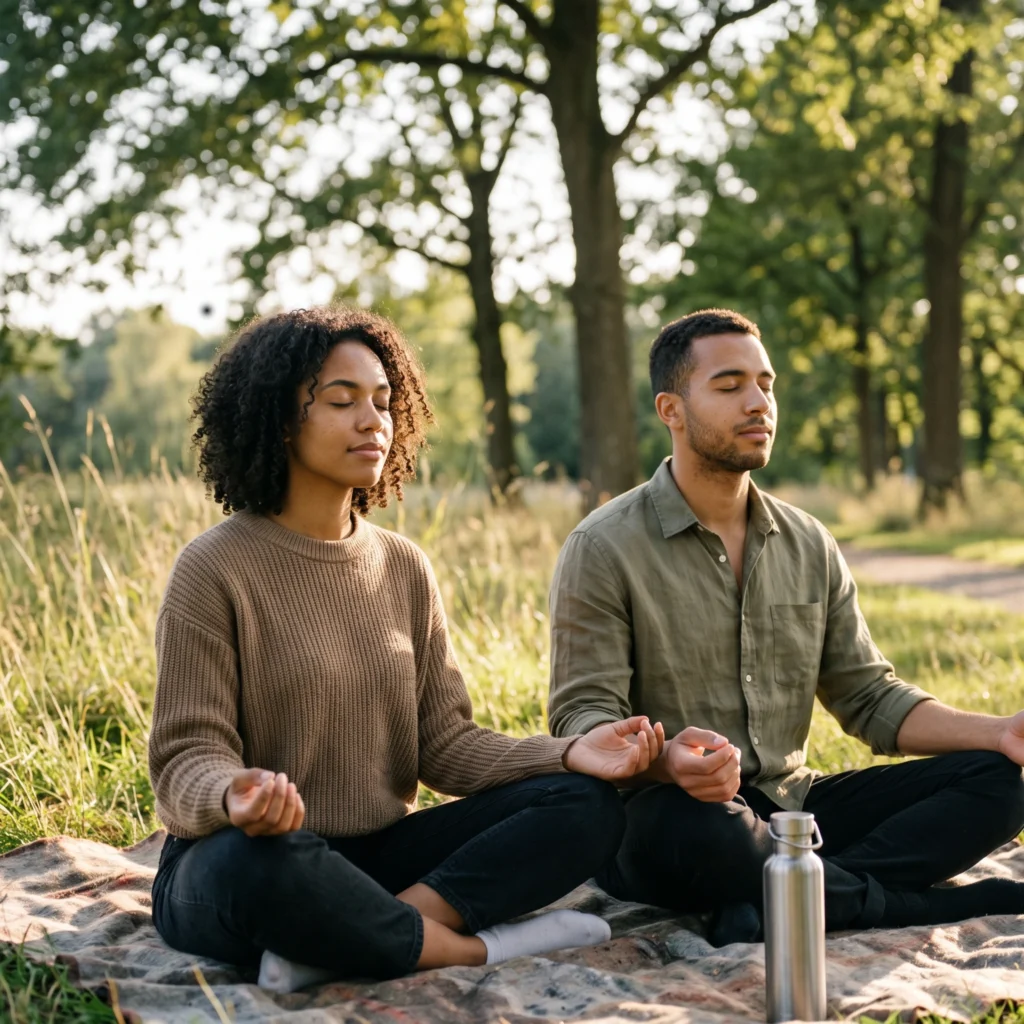
Stress is part of everyday life for many people – but the way you breathe can have an enormous impact on how your body responds to stressful situations. While we take approximately 17,000 to 30,000 breaths each day, this mostly happens completely unconsciously. Yet within the conscious control of your breathing lies a powerful tool for stress reduction and for promoting your mental and physical health. In this article, we introduce you to two particularly effective breathing techniques: Pranayama from the millennia-old yoga tradition and the modern Buteyko method. Both approaches offer you scientifically grounded ways to reduce stress, improve your health, and bring more calm into your life.
Why breathing exercises are so effective against stress
The connection between breathing and the nervous system is direct and immediate. Your autonomic nervous system consists of two main components: the sympathetic nervous system, which is responsible for the stress response, and the parasympathetic nervous system, which promotes relaxation and recovery. The special quality of breathing lies in the fact that it is both automatic and voluntarily controllable – and it is precisely this bridge that makes it a unique gateway to regulating your nervous system.
When you are stressed, your breathing automatically becomes faster and shallower. This mechanism prepares your body for a fight-or-flight response. Conversely, by breathing consciously slowly and deeply, you can signal to the brain that there is no danger, thereby activating the parasympathetic nervous system. This leads to measurable physiological changes: your heart rate slows down, blood pressure may decrease, muscle tension reduces, and stress hormones such as cortisol can be lowered.
Pranayama: The art of yogic breath control
Pranayama originates from Sanskrit and is composed of “Prana” (life energy) and “Ayama” (expansion or control). This ancient practice is a central component of yoga and encompasses a wide variety of breathing techniques aimed at harmonizing the flow of energy in the body and calming the mind.
The scientific basis of Pranayama
Modern research has examined various positive effects of Pranayama exercises. Studies show that regular practice can improve heart rate variability – an important indicator of your nervous system’s adaptability and your stress resilience. Further research suggests that Pranayama can lower cortisol levels, reduce anxiety, and enhance concentration. Positive effects have also been observed in studies involving high blood pressure and chronic stress. Research on Pranayama is continually evolving, and many of its effects are increasingly being scientifically documented.
Nadi Shodhana: Alternate nostril breathing
One of the most well-known Pranayama techniques is Nadi Shodhana, also known as alternate nostril breathing. This exercise can help you achieve a state of deep relaxation.
Here is how to perform alternate nostril breathing: Sit upright and comfortably. Place your index and middle fingers of your right hand between your eyebrows, or fold them toward your palm. Use your thumb to close your right nostril and inhale calmly through your left nostril. Then close your left nostril with your ring finger, open your right nostril, and exhale through it. Now inhale through your right nostril, close it, open your left nostril, and exhale through it. That is one round. Begin with 5–10 rounds and increase gradually. Your breathing should always remain calm and comfortable throughout.
Ujjayi: The oceanic breath
Ujjayi, also known as oceanic breathing, creates a gentle sound in the throat and helps you slow down and deepen your breathing. This technique can stimulate the vagus nerve and thereby promote the relaxation response.
For Ujjayi, breathe in and out through your nose while slightly constricting your glottis. Imagine you want to fog up a mirror, but with your mouth closed. The resulting sound should be soft and even, similar to the sound of the ocean. This technique is well suited for integration into your daily life, as it can be practiced unobtrusively.
Bhramari: The humming bee breath
Bhramari can be particularly helpful during acute stress and anxiety. The vibrating humming sound can have a calming effect on your nervous system and interrupt negative thought patterns.
Sit comfortably and gently close your ears with your thumbs, while the remaining fingers rest softly on your face. Inhale calmly through your nose and produce a humming sound as you exhale, like a bee. Feel the vibration throughout the entire head area. Repeat this 5–10 times and observe how your mind becomes calmer.
The Buteyko method: Less is more
While Pranayama looks back on a millennia-old tradition, the Buteyko method is a relatively modern development. Soviet physician Konstantin Buteyko developed it in the 1950s based on the observation that many of his patients exhibited altered breathing patterns that potentially contributed to various health problems.
The concept of overbreathing
The central thesis of the Buteyko method is: many people breathe too much, too fast, and too shallowly – often through the mouth rather than through the nose. This chronic hyperventilation can lead to an imbalance between oxygen and carbon dioxide in the blood. A certain level of CO2 is important for oxygen to be efficiently released from red blood cells to the cells (the Bohr effect).
Chronic overbreathing can be accompanied by symptoms such as dizziness, fatigue, difficulty concentrating, sleep disturbances, and increased susceptibility to stress. The Buteyko method was originally developed to support asthma management and is being studied in some research as a complementary measure.
The core principles of the Buteyko method
The Buteyko method aims to normalize your breathing volume and teach you to breathe more calmly, more slowly, and exclusively through your nose. The three core principles are: prioritizing nasal breathing, reducing breathing volume, and practicing conscious breath holds.
The control pause test
A central element of the Buteyko method is the control pause test, which allows you to assess your current breathing state. Sit in a relaxed position and breathe normally. After a normal exhale, hold your nose and time how long it takes until you feel the first distinct urge to breathe in again. This is not the point of maximum air hunger, but rather the first noticeable breathing impulse. According to Buteyko, a control pause of 40 seconds or more is considered optimal, 25–40 seconds as average, and under 25 seconds as an indication of possible overbreathing. However, these values should be considered individually.
Buteyko exercises for everyday life
Reduced breathing is a foundational exercise of the Buteyko method. Sit upright and breathe exclusively through your nose. Consciously reduce your breathing volume so that you inhale slightly less air than usual. You should feel a mild sense of air hunger – not so strong that it becomes uncomfortable, but clearly noticeable. Try to maintain this reduced breathing pattern for 3–5 minutes. Over time, your body can become accustomed to a calmer breathing pattern.
Another exercise involves breath holds while walking. After a normal exhale, hold your breath, take a few steps (perhaps 10–20 steps to begin with), and then continue breathing in a controlled manner through your nose. This exercise can increase your CO2 tolerance and train your body.
Nasal breathing: A core principle
Nasal breathing is a central aspect of the Buteyko method. The nose filters, warms, and humidifies the air you breathe, and produces nitric oxide, which has antibacterial properties and can support oxygen uptake. The Buteyko method recommends breathing through the nose both during the day and at night. If you breathe through your mouth at night, there are specialized aids such as mouth tape that can encourage nasal breathing. Consult a doctor if needed, especially if you have respiratory conditions.
Pranayama and Buteyko: Similarities and differences
Both methods emphasize the importance of nasal breathing and conscious breath control, yet differ in their approach. Pranayama employs a wide variety of techniques with different rhythms and patterns intended to achieve specific effects. The Buteyko method, on the other hand, focuses on normalizing breathing and correcting overbreathing.
Interestingly, both approaches can complement each other well. While Buteyko helps you establish calm baseline breathing in everyday life, Pranayama offers targeted exercises for various situations and goals. Alternate nostril breathing from Pranayama, for example, can serve as a relaxing practice, while Buteyko principles can optimize your everyday breathing.
Practical integration into your daily life
The greatest benefit arises when you practice breathing exercises regularly. Begin with 5–10 minutes per day and choose a time that fits well into your daily routine – for example, in the morning after waking up or in the evening before going to sleep.
As a starting point, you can begin with a simple Pranayama exercise such as alternate nostril breathing and simultaneously establish nasal breathing according to Buteyko principles in your daily life. Pay particular attention to breathing through your nose even during light physical activity. This may feel challenging at first, but it can train your breathing efficiency.
During acute stress, you can use Bhramari or Ujjayi to calm yourself. The Buteyko control pause works well as a regular check-in to monitor your progress. Document your experiences in a breathing journal – this way you can identify patterns and tailor your practice accordingly.
Precautions and when you should be careful
Although breathing exercises are generally considered safe, there are some situations where caution is advised. If you have serious cardiovascular conditions, are pregnant, have epilepsy, or are dealing with acute respiratory infections, you should seek medical advice before beginning an intensive breathing practice. Intensive breathwork can also sometimes be challenging for people with panic disorders or a trauma background – in these cases, professional guidance is advisable.
Always begin gently and increase intensity only gradually. If dizziness, severe discomfort, or pain occurs, stop the exercise and return to your normal breathing. Breathing exercises should feel pleasant and should not be forced. If symptoms persist, consult a doctor.
Conclusion: Your breath as the key to greater calm
Pranayama and the Buteyko method offer you two powerful, increasingly scientifically studied approaches to managing stress and promoting your well-being. While Pranayama with its diverse techniques can specifically support various states, the Buteyko method helps you establish calm baseline breathing and correct overbreathing. Both methods emphasize the central importance of nasal breathing and conscious breath control.
The beauty of breathing exercises lies in their accessibility: you need no special equipment, no particular location, and only a few minutes of your time. Your breath is always with you and can be used as a tool for greater well-being. Start today with a simple exercise and observe how your stress resilience, your energy, and your quality of life can develop over time. The investment of just a few minutes each day can have positive effects on your physical and mental health – a worthwhile path toward greater calm and inner balance.
Dieser Ratgeber dient ausschließlich zu Informationszwecken und ersetzt keine medizinische Beratung oder Diagnose. Bei anhaltenden Beschwerden konsultieren Sie bitte einen Arzt. Nahrungsergänzungsmittel und Heilpflanzen sollten nicht ohne Rücksprache mit einem Therapeuten eingenommen werden.