
Anxiety is a feeling that everyone knows
Sometimes it’s quiet and creeping, sometimes overwhelming and paralyzing. Your heart races, your thoughts spin, and suddenly you feel trapped in a vice. The good news: your breath can be your powerful ally in dealing with anxiety. Two particularly well-known methods have emerged in recent years: the Buteyko Method and Coherent Breathing. Both techniques use the connection between breathing and the nervous system to reduce anxiety.
In this article, you’ll learn how these two breathing techniques work, why they can be effective for anxiety, and how you can integrate them step by step into your daily life. These methods can support you long-term in dealing with stress and anxiety.
Why breathing and anxiety are so closely connected
Before we turn to the specific techniques, it’s important to understand why your breathing has any influence on your anxiety at all. The connection between breath and emotions is scientifically proven.
Your autonomic nervous system controls involuntary bodily functions and consists of two main parts: the sympathetic nervous system, which is responsible for the stress response, and the parasympathetic nervous system, which provides relaxation and regeneration. During anxiety, your body switches into fight-or-flight mode, activated by the sympathetic nervous system. Breathing becomes faster and shallower, heart rate accelerates, stress hormones are released.
The special thing: breathing is the only function of the autonomic nervous system that you can consciously control. By changing your breathing, you send direct signals to your nervous system and can switch from stress mode to relaxation mode. This ability makes breathing exercises a valuable tool for anxiety.
The Buteyko Method: Less is more
The Buteyko Method was developed in the 1950s by Russian physician Konstantin Buteyko. His central insight was: many people chronically breathe too much, which can contribute to various health problems – including anxiety and panic attacks.
The principle of overbreathing
When you’re under stress or anxiety, you tend to breathe faster and deeper. This sounds harmless at first, but leads to a drop in carbon dioxide levels (CO₂) in your blood. Many think CO₂ is just a waste product, but it plays an important role in oxygen delivery to your cells and the regulation of your pH level.
A CO₂ level that’s too low can paradoxically lead to your cells receiving less oxygen, even though you’re breathing more. This condition, called hypocapnia, can trigger symptoms that amplify anxiety: dizziness, heart palpitations, tingling in hands and feet, lightheadedness, and a feeling of breathlessness. A vicious cycle can develop: anxiety leads to overbreathing, overbreathing intensifies anxiety symptoms.
How the Buteyko Method works
The Buteyko Method aims to reduce your breathing volume and normalize your CO₂ levels. The basic principle is simple: breathe less, slower, and through the nose.
The Control Pause: A central exercise of the Buteyko Method is the Control Pause. It measures your CO₂ tolerance and indicates how efficiently your respiratory center is working. After a normal exhale, you hold your breath until you feel the first clear urge to breathe. The time until this point is your Control Pause. A Control Pause under 20 seconds can indicate overbreathing, values around 40 seconds or more are considered good.
Nasal breathing: A cornerstone of the method is breathing exclusively through the nose – both during the day and at night. Nasal breathing warms, humidifies, and filters the air and automatically slows down your breathing.
Practical Buteyko exercise for anxiety
When you feel a wave of anxiety, try this simple exercise:
- Sit or stand upright.
- Breathe normally in and out through your nose.
- After a natural exhale, gently hold your nose closed with your fingers and hold your breath.
- Walk in place or move slightly while holding your breath.
- When you feel a clear urge to breathe, inhale through your nose – calmly and controlled, not deeply.
- Continue breathing in a reduced manner for about 30 seconds, as if breathing through a straw.
- Repeat this sequence three to five times.
This exercise increases your CO₂ levels, activates your parasympathetic nervous system, and can interrupt the anxiety cycle. Many people report a calming effect.
Coherent Breathing: The rhythm of calm
Coherent Breathing, also known as resonant breathing, is a technique that comes from heart rate variability research. It’s based on a simple but powerful principle: breathing in a specific rhythm can synchronize your heart, breathing, and nervous system.
What does coherence mean?
Coherence describes a state in which different body systems work together harmoniously. Your heartbeat naturally varies – it accelerates during inhalation and slows during exhalation. This heart rate variability (HRV) is a sign of health and adaptability.
During stress and anxiety, this pattern often becomes chaotic and irregular. Coherent Breathing can create a smooth, wave-like pattern in your heart rate that signals relaxation. Your brain receives this message and can reduce the anxiety response.
The optimal breathing frequency
Research has shown that a breathing rate of about five to six breaths per minute can produce coherence in many people. This means: about five seconds inhaling, five seconds exhaling. This rhythm lies in the so-called resonant frequency, where your cardiovascular system and respiratory system can oscillate harmoniously.
This slow breathing activates your parasympathetic nervous system, can lower blood pressure and heart rate, reduce stress hormones, and promote calming neurotransmitters. At the same time, it can improve blood flow and oxygen supply to your brain, which can contribute to clearer thoughts and better emotional regulation.
Practical Coherent Breathing exercise
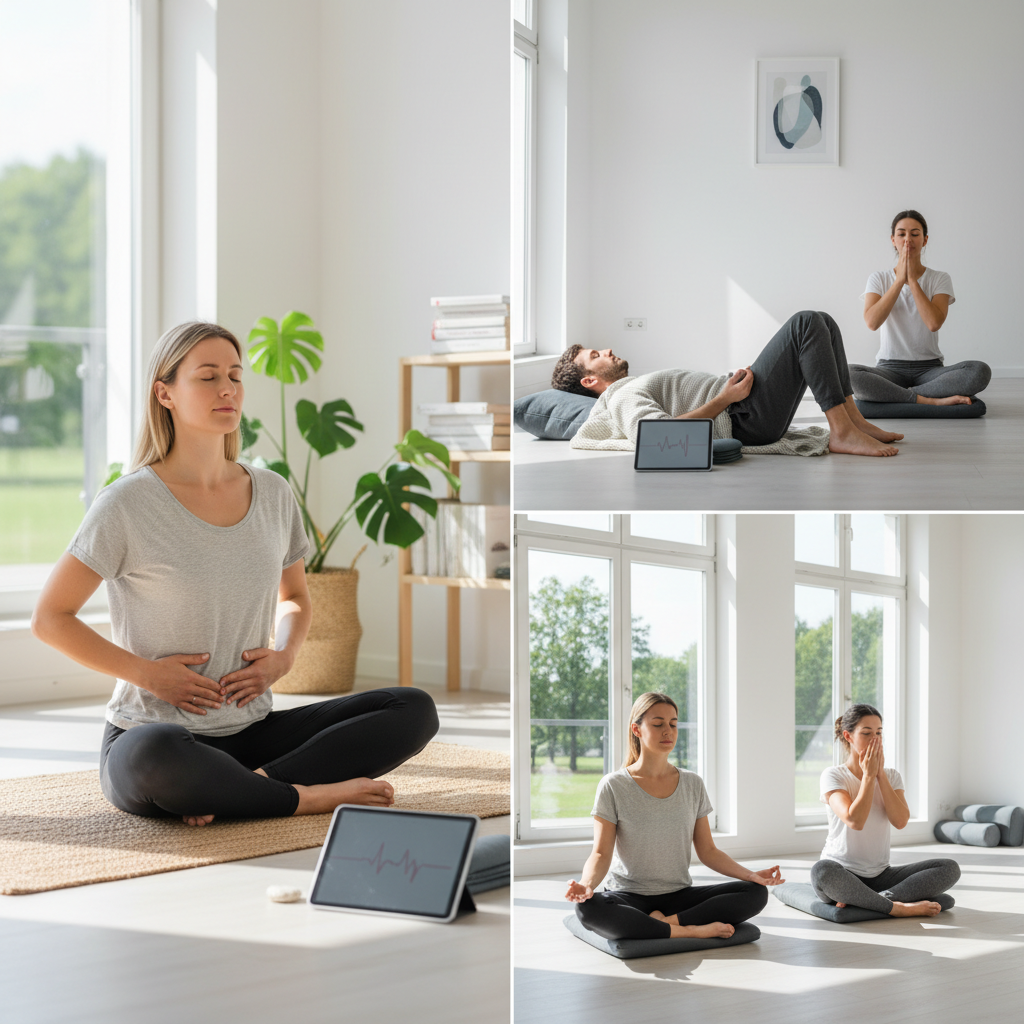
Coherent Breathing is remarkably simple and can be performed anywhere:
- Sit comfortably with a straight back.
- If possible, place one hand on your heart or belly.
- Breathe gently in through your nose and count slowly to five (about five seconds).
- Breathe out through your nose or slightly opened mouth and count to five again.
- Don’t pause between inhalation and exhalation, but let the breath flow.
- Repeat this for at least five minutes, ideally ten to twenty minutes.
It’s important that your breathing remains effortless. If five seconds feels too long, start with four seconds in and four seconds out. Over time, the rhythm can feel more natural.
Scientific evidence and effectiveness
Both methods have been scientifically studied. Studies on the Buteyko Method show improvements in asthma, respiratory diseases, and stress-related symptoms. Reduced breathing can demonstrably contribute to an improvement in CO₂ tolerance and a reduction of hyperventilation symptoms that can be associated with panic attacks.
Coherent Breathing has been investigated in numerous studies that suggest its effectiveness for anxiety disorders, depression, PTSD, and stress-related conditions. A study from 2017 showed, for example, that just ten minutes of Coherent Breathing daily over eight weeks can lead to reductions in anxiety symptoms. Participants reported not only less anxiety, but also better sleep and increased well-being.
Particularly positive is that these techniques have hardly any side effects and can be combined with other forms of treatment. They can also give you a sense of control and self-efficacy – factors that are often impaired in anxiety disorders.
Which method is right for you?
Both techniques have their strengths, and the choice depends on your individual needs and preferences.
The Buteyko Method is particularly suitable if you tend toward hyperventilation, often have the feeling of not getting enough air, or suffer from panic attacks. It can also be helpful if you breathe through your mouth or suffer from respiratory problems like asthma. The focus is on long-term retraining of your breathing pattern and increasing your CO₂ tolerance.
Coherent Breathing is ideal if you’re looking for a simple, rhythmic exercise that you want to practice daily. It works well as a meditation practice and for general stress reduction. Many people find the steady rhythm particularly calming and easy to learn.
You can also combine both methods: use the Buteyko Method to improve your basic breathing pattern and manage acute anxiety, and use Coherent Breathing as a daily preventive practice to strengthen your stress resilience.
Tips for successful integration into daily life
As with any new habit, regularity is the key to success. Start with short practice sessions of five minutes daily and gradually increase. Choose fixed times, such as in the morning after waking up or in the evening before going to bed.
Use apps or timers that support you with the rhythm. For Coherent Breathing, there are numerous free apps with visual or acoustic breathing guides. Be patient with yourself – it can take several weeks until noticeable changes occur.
It’s also important that you don’t only apply these exercises in crisis moments, but establish them as a preventive practice. A trained nervous system reacts less strongly to stressors, and regular breathing exercises can increase your basic resilience against anxiety.
If you suffer from severe anxiety disorders, breathing exercises don’t replace professional therapy, but can effectively complement it. Talk to your therapist or doctor about integrating breathing techniques into your treatment plan.
Conclusion: Your breath as an anchor in stormy times
Both the Buteyko Method and Coherent Breathing offer you scientifically studied, low-side-effect tools for dealing with anxiety. They remind you that you’re not helpless when anxiety comes – your breath is always with you, as a constantly available instrument for self-regulation.
The Buteyko Method teaches you to breathe less and normalize your CO₂ balance, which can be particularly effective for hyperventilation and panic attacks. Coherent Breathing creates harmony between heart, breath, and nervous system through its rhythmic approach and can sustainably reduce your stress level.
Start today with one of the methods – just a few minutes can make a difference. With regular practice, you may find that not only your breathing changes, but also your relationship to anxiety and stress. You can develop more composure, self-confidence, and the ability to stay with yourself even in difficult moments.
Your breath is more than just air flowing in and out – it’s a bridge between body and mind, a tool for self-regulation, and an anchor in stormy times. Use this power that’s available to you at any time.
Dieser Ratgeber dient ausschließlich zu Informationszwecken und ersetzt keine medizinische Beratung oder Diagnose. Bei anhaltenden Beschwerden konsultieren Sie bitte einen Arzt. Nahrungsergänzungsmittel und Heilpflanzen sollten nicht ohne Rücksprache mit einem Therapeuten eingenommen werden.