
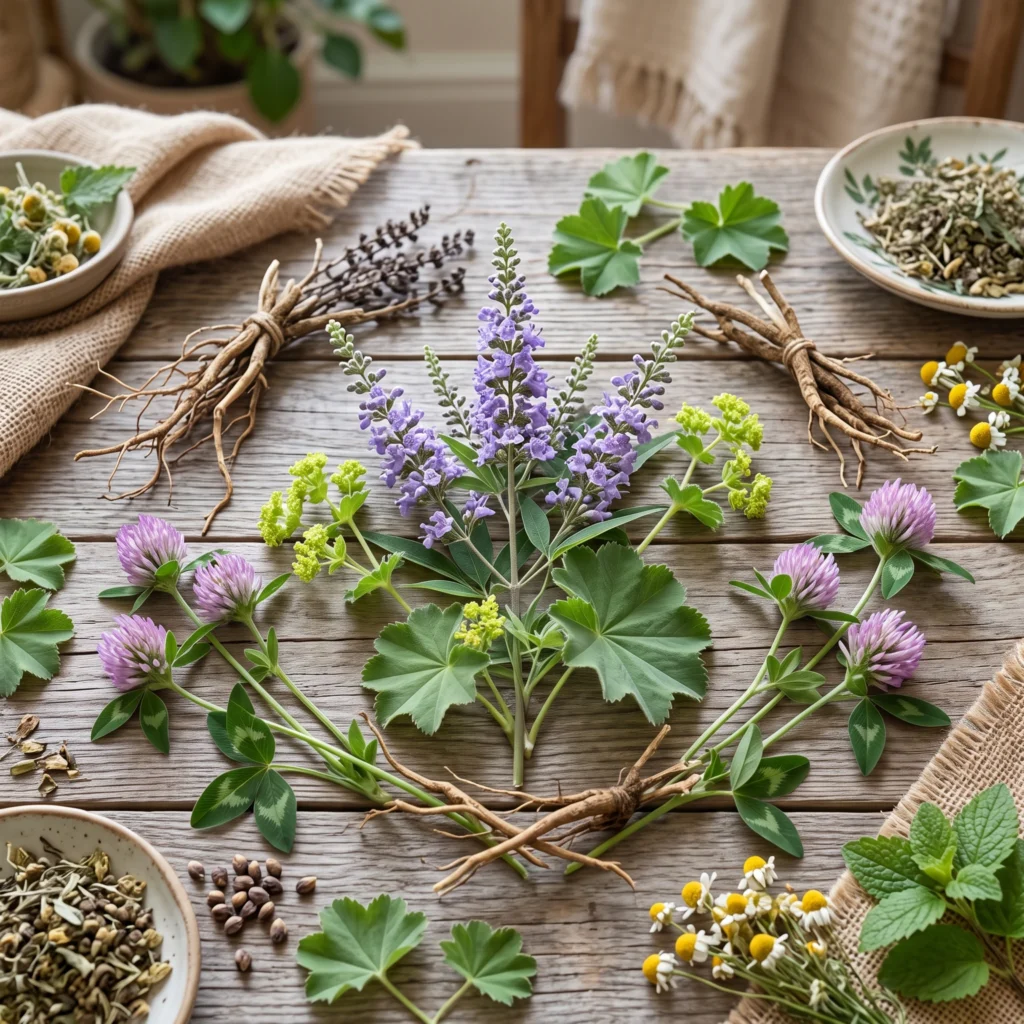
Do you sometimes feel tired, moody, or just not quite in balance? Hormonal fluctuations are often behind this, affecting many women throughout their lives. The good news: nature has helpers available to gently support your hormonal balance. In this article, you’ll learn how phytotherapy – the healing power of plants – can help you balance your hormones naturally.
What are hormones and why do they become unbalanced?
Hormones are chemical messengers that control numerous processes in your body – from your cycle to your mood to your energy levels. The sex hormones estrogen and progesterone in particular play a central role in the female body. When these become unbalanced, you often feel it clearly.
The causes of hormonal imbalances are varied: stress, lack of sleep, an unbalanced diet, environmental pollutants, or certain life phases such as puberty, pregnancy, or menopause can influence your hormonal system. Conditions such as polycystic ovary syndrome (PCOS) or thyroid problems also affect your hormone levels.
Typical symptoms of hormonal imbalance
A disrupted hormone balance can manifest in various ways. You may recognize some of these symptoms in yourself:
Irregular or painful periods, premenstrual symptoms (PMS), mood swings, and irritability are among the most common signs. Sleep disturbances, unexplained weight changes, skin problems such as acne, hair loss, or increased hair growth in unusual places can also indicate a hormonal imbalance. Many women also report reduced libido, lack of energy, and difficulty concentrating.
If you notice several of these symptoms in yourself, you should first speak with your doctor to rule out serious conditions. Phytotherapy can then be a valuable addition to conventional treatments.
What is phytotherapy and how does it work?
Phytotherapy refers to healing treatments using plants and their active compounds. Unlike homeopathy, these are measurable, pharmacologically active substances. Herbal preparations can influence your hormone balance in various ways: they contain phytohormones that have similar structures to the body’s own hormones, can influence hormone production, or modulate the receptors where hormones dock.
The great advantage of phytotherapy lies in its generally good tolerability. However, “natural” does not automatically mean “harmless” – you should use herbal remedies with care and, if in doubt, consult a specialist.
The most important medicinal plants for hormonal balance
Chaste tree (Vitex agnus-castus)
The chaste tree is one of the most extensively researched medicinal plants for women’s health. The plant acts on the pituitary gland – your body’s “hormone control center” in the brain – and can regulate the release of the hormone prolactin there. Elevated prolactin levels can lead to cycle disorders and PMS.
Studies show that chaste tree can be helpful for premenstrual complaints. The plant may reduce breast tenderness, balance mood swings, and improve the regularity of your cycle. Chaste tree is also used in cases of unfulfilled desire to have children when a luteal phase deficiency is suspected.
However, the effect only sets in after several weeks of regular use. Experts recommend taking chaste tree for at least three months to observe a possible improvement.
Lady’s mantle (Alchemilla vulgaris)
Lady’s mantle is traditionally used for various women’s complaints. The plant contains tannins and is used in folk medicine to regulate the female cycle. Lady’s mantle is traditionally used especially in the second half of the cycle.
You can drink lady’s mantle as a tea – it is frequently used in combination with yarrow in particular. However, the scientific evidence is limited, and the effect is based primarily on empirical values.
Wild yam (Dioscorea villosa)
Wild yam contains diosgenin, a substance whose structure is similar to steroid hormones. It is therefore frequently recommended for hormonal complaints, such as during menopause or with premenstrual symptoms.
Important to know: the human body cannot directly convert diosgenin into progesterone – this conversion is only possible in a laboratory. The therapeutic efficacy of wild yam is not sufficiently scientifically proven. Wild yam is available as tea, capsules, or as a cream for external use.
Red clover (Trifolium pratense)
Red clover contains isoflavones – plant-based substances known as phytoestrogens. These can dock onto estrogen receptors in the body and are particularly interesting during menopause, when estrogen levels naturally decline.
Some studies suggest that red clover can reduce hot flashes, however the study results are inconsistent. If you have estrogen-dependent conditions such as certain types of breast cancer, you should only use red clover after consulting your doctor.
Black cohosh (Cimicifuga racemosa)
This North American medicinal plant is a classic in the treatment of menopausal complaints. Black cohosh may possibly relieve hot flashes, night sweats, sleep disturbances, and depressive moods.
The exact mechanism of action has not yet been fully clarified, but several studies confirm a certain efficacy for menopausal complaints. The plant is considered well-tolerated, but should not be used in cases of liver disease. Here too: be patient, as the effect only becomes apparent after several weeks.
St. John’s wort (Hypericum perforatum)
St. John’s wort is recognized as an herbal remedy for mild to moderate depression and can also be helpful for hormonally related mood swings. Particularly for PMS with pronounced psychological symptoms or during menopause, St. John’s wort can positively influence your mood.
Please note, however: St. John’s wort can affect the efficacy of various medications, including the contraceptive pill, antidepressants, blood thinners, and many others. If you use hormonal contraception or take other medications, be sure to speak with your doctor beforehand.
Phytotherapy in different life phases
For PMS and menstrual complaints
If you suffer from premenstrual complaints every month, a combination of chaste tree, lady’s mantle, and St. John’s wort may be considered. Chaste tree is used for cycle regulation, lady’s mantle is traditionally used for the second half of the cycle, and St. John’s wort can lift your mood.
Yarrow and silverweed are also traditionally used for cramps during menstruation. A warm tea made from these herbs is described as antispasmodic.
For an irregular cycle
An irregular cycle can have various causes and should be medically evaluated. Chaste tree is often an option here, as it can have a regulating effect on hormone release. In addition, raspberry leaf tea and lady’s mantle are traditionally used to stabilize the cycle.
During menopause
Menopause is a natural phase of hormonal change. Black cohosh and red clover are the most frequently studied herbal remedies here. They may possibly relieve typical complaints such as hot flashes, sleep disturbances, and mood swings.
Sage is also traditionally used for night sweats – whether as tea, tincture, or in capsule form. The perspiration-inhibiting effect is reported by many users.
Additional supportive measures for hormonal balance
Phytotherapy works best in conjunction with a healthy lifestyle. Pay attention to a balanced diet with plenty of fresh vegetables, healthy fats, and sufficient protein. Omega-3 fatty acids are particularly important, as they can have an anti-inflammatory effect.
Moderate sugar consumption is recommended, as strong fluctuations in blood sugar can place additional strain on your hormone balance. Avoiding excessive alcohol and caffeine can also improve symptoms in some women.
Stress management is also important: chronic stress raises cortisol levels and can affect other hormones. Yoga, meditation, breathing exercises, or regular breaks can be supportive here.
Sufficient sleep is important for your hormone production. Try to go to bed at a similar time each evening and sleep for around seven to nine hours. Darkness in the bedroom is important for melatonin production.
What you should pay attention to when using phytotherapy
Even though herbal remedies are natural, there are some things you should bear in mind. Purchase preparations of tested quality to ensure a consistent amount of active ingredients. Products of unknown origin may be contaminated with pollutants or be underdosed.
Give the plants time to work – with most phytotherapeutic remedies, it takes several weeks to months before you notice a possible improvement. Regularity is important.
If you are pregnant, breastfeeding, or suffering from chronic conditions, you should always consult your doctor or pharmacist before taking herbal preparations. Interactions with medications are also possible.
Observe your body and its reactions. It is best to keep a symptom diary in which you record your complaints and the intake of the plants. This will help you better assess what is helping you.
Conclusion: Natural support for hormonal balance
Phytotherapy offers you various ways to gently support your hormonal balance. From chaste tree for PMS to black cohosh during menopause to lady’s mantle for cycle disorders – nature has traditionally tried and tested approaches for many complaints.
It is important that you understand: phytotherapy requires patience and consistency, ideally in combination with a holistic approach. Together with a healthy lifestyle, balanced diet, sufficient sleep, and effective stress management, medicinal plants can provide supportive benefits.
If your complaints are severe or do not improve despite natural measures, do not hesitate to seek professional help. An experienced gynecologist, naturopath, or phytotherapist can advise you individually and create a treatment plan tailored to you.
Ultimately, it is about feeling comfortable in your body and living in harmony with your natural rhythms. Phytotherapy can be a valuable companion on this journey – try it in consultation with specialists and observe how the power of plants can support you.
Dieser Ratgeber dient ausschließlich zu Informationszwecken und ersetzt keine medizinische Beratung oder Diagnose. Bei anhaltenden Beschwerden konsultieren Sie bitte einen Arzt. Nahrungsergänzungsmittel und Heilpflanzen sollten nicht ohne Rücksprache mit einem Therapeuten eingenommen werden.