
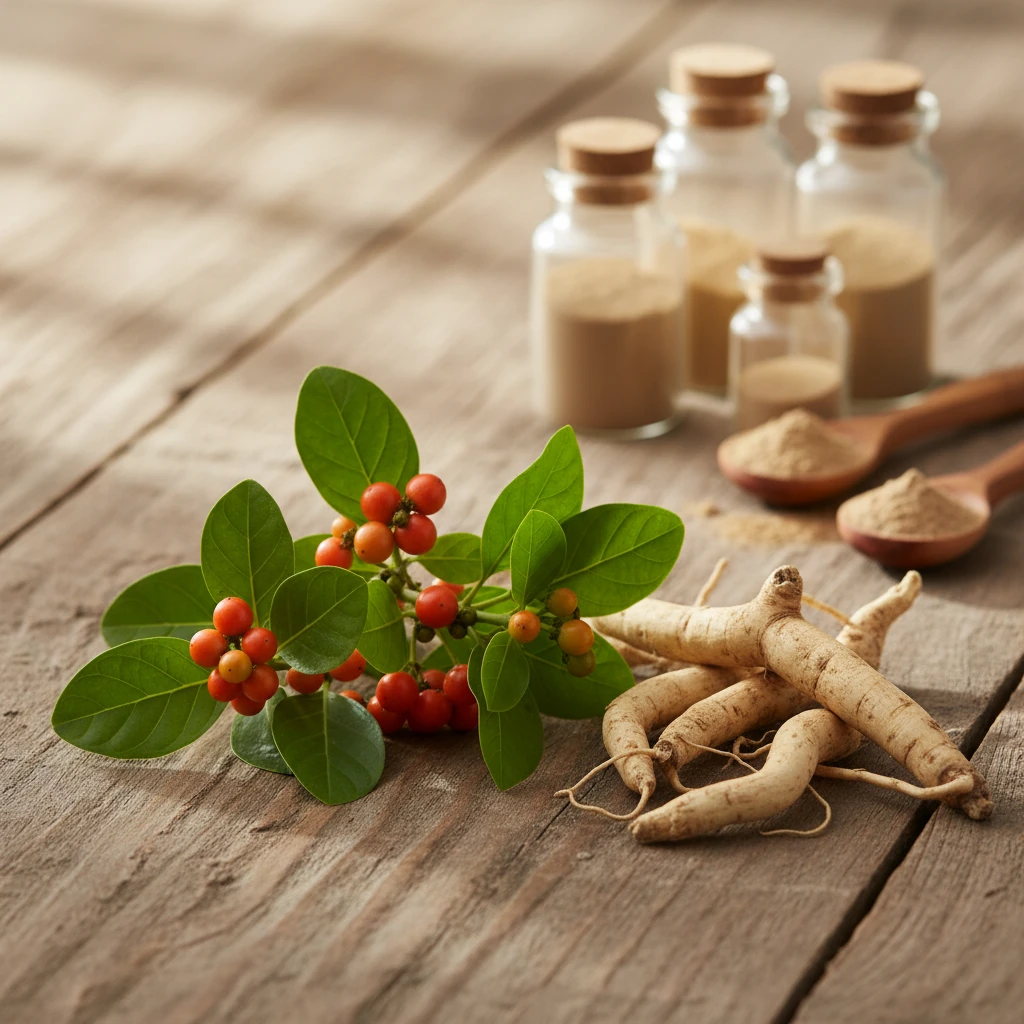
Ashwagandha is considered one of the most important medicinal plants in traditional Indian Ayurvedic medicine and is also enjoying growing popularity in this country. The adaptogenic plant, botanically known as Withania somnifera, has been used for over 3,000 years to strengthen body and mind. But what is really behind this powerful natural remedy? In this article, you will learn everything worth knowing about the effects, application, and correct dosage of Ashwagandha.
What is Ashwagandha?
Ashwagandha, also known as Indian ginseng or winter cherry, is a shrub from the nightshade family. The plant grows mainly in India, the Middle East, and parts of Africa. The name “Ashwagandha” comes from Sanskrit and translates to “smell of the horse” – an allusion to the characteristic smell of the root as well as the traditional belief that the plant imparts the strength and vitality of a horse.
Primarily the roots and leaves of the plant are used medicinally, which contain a variety of bioactive compounds. Among the most important constituents are the so-called withanolides – steroid-like molecules that are credited with a large part of the health-promoting properties.
Ashwagandha as an Adaptogen: What Does That Mean?
Ashwagandha is classified in the group of adaptogens – these are natural substances that are supposed to help the body better adapt to stressful situations and restore inner balance. Adaptogens have a regulating effect on various body systems and can intervene in a balancing way in both over- and under-functioning.
The special property of adaptogens lies in the fact that they do not have a one-sided stimulating or calming effect, but can intervene harmoniously depending on the organism’s needs. For Ashwagandha, this specifically means: the plant can have a calming effect in stress, but at the same time can also be vitalizing and energizing in cases of exhaustion.
The Most Important Effects of Ashwagandha
Stress Reduction and Anxiety Relief
The probably best-known and most researched effect of Ashwagandha is its stress-reducing property. Numerous studies have shown that taking Ashwagandha extract can lower cortisol levels – our primary stress hormone. A systematic review from 2019 confirmed that Ashwagandha can contribute to an improvement in symptoms in people with chronic stress and anxiety disorders.
Ashwagandha interacts with the GABA system in the brain, which is responsible for calming neuronal activity, and modulates the hypothalamic-pituitary-adrenal axis, the central stress axis of our body.
Improvement of Cognitive Functions
Ashwagandha also shows promising effects on mental performance. Studies indicate that the plant can improve memory, attention, and information processing speed. These neuroprotective properties are attributed to antioxidant effects as well as the ability to protect nerve cells from degeneration.
Particularly interesting is the potential effect in neurodegenerative diseases. Initial research suggests that Ashwagandha could reduce the formation of beta-amyloid plaques associated with Alzheimer’s. However, these studies are still in an early stage and have predominantly been conducted in animal and laboratory models.
Promotion of Sleep and Recovery
The botanical name “somnifera” means “sleep-inducing” – and indeed Ashwagandha can improve sleep quality. The calming effect on the nervous system helps many people fall asleep faster and sleep more deeply. Especially with stress-related sleep disorders, the plant proves to be valuable natural support.
A randomized double-blind study from 2020 found that participants who took Ashwagandha showed improvements in sleep onset time, sleep duration, and sleep efficiency.
Support of Physical Performance
For physically active people, it is particularly interesting that Ashwagandha can increase physical performance. Studies show positive effects on muscle strength, endurance, and recovery after training. The plant can also help improve body composition by promoting muscle building while simultaneously reducing body fat percentage.
Some studies have demonstrated that Ashwagandha can lead to an increase in men with low testosterone levels, which could have positive effects on strength, libido, and general well-being.
Immune System and Anti-Inflammation
Ashwagandha possesses immunomodulatory properties that can strengthen the immune system. The plant increases the activity of natural killer cells and other immune cells that are important for fighting pathogens. At the same time, Ashwagandha has anti-inflammatory effects by reducing the production of pro-inflammatory cytokines.
This anti-inflammatory effect could be beneficial in chronic inflammatory conditions associated with numerous lifestyle diseases, from arthritis to cardiovascular diseases.
Applications of Ashwagandha
Based on the described effects, Ashwagandha is suitable for various areas of application:
Stress management and burnout prevention: In chronic stress, work overload, or stressful life phases, Ashwagandha can help increase stress resistance and support inner balance.
Sleep problems: For difficulty falling asleep and staying asleep, especially when stress-related, the plant offers natural support.
Cognitive performance enhancement: In phases of high mental demands, such as during exam periods or challenging projects, Ashwagandha can promote concentration and memory performance.
Athletic performance: For athletes and fitness enthusiasts, the plant can contribute to performance enhancement, better recovery, and muscle building.
Hormonal balance: In hormonal imbalances, especially with low testosterone in men, Ashwagandha can have a regulating effect.
Dosage: How Much Ashwagandha Should You Take?
The optimal dosage of Ashwagandha depends on various factors, including the form of the preparation, the concentration of active ingredients, and the individual application goal.
Standard Dosage
Most scientific studies use daily doses between 300 and 600 mg of a standardized root extract, often divided into two doses. Standardized extracts typically contain 5–10% withanolides – the main active ingredients of the plant.
For non-standardized root powders, higher doses of 3,000 to 6,000 mg daily are often recommended, as the active ingredient concentration is lower here.
Dosage by Purpose
- For stress and anxiety: 300–500 mg extract twice daily
- For better sleep: 300–600 mg about one hour before bedtime
- For performance enhancement: 500–600 mg daily, preferably in the morning or before training
- For cognitive functions: 300–500 mg twice daily
Administration Instructions
Ashwagandha should ideally be taken with meals to increase bioavailability and avoid possible stomach discomfort. The effect does not occur immediately – for noticeable effects, you should give the supplement at least 2–4 weeks. Many people report optimal results after 6–12 weeks of continuous intake.
It is recommended to start with a lower dose and gradually increase it if needed. This way you can observe how your body responds to the adaptogen and find the ideal dosage for you.
Forms of Ashwagandha
Ashwagandha is available in various forms:
Capsules and tablets: The most practical form for accurate dosage. Look for standardized extracts with defined withanolide content.
Powder: The traditional root powder can be stirred into smoothies, juices, or warm milk (traditionally as “Moon Milk”). This form is often cheaper but requires more care in dosing.
Liquid extracts and tinctures: Allow flexible dosing and are quickly absorbed by the body.
Tea: A mild form of intake, however with lower active ingredient concentration.
Side Effects and Precautions
Ashwagandha is generally considered well tolerated. When used as directed, side effects occur rarely. Possible adverse effects may include:
- Mild gastrointestinal complaints such as nausea or diarrhea, especially at higher doses or when taken on an empty stomach
- Fatigue in some individuals, especially at the beginning of intake
- Headaches in rare cases
Contraindications
Pregnancy and breastfeeding: Ashwagandha should not be taken during these phases as it may have labor-inducing properties and the data on safety is insufficient.
Autoimmune diseases: Since Ashwagandha can stimulate the immune system, people with autoimmune diseases such as lupus, rheumatoid arthritis, or multiple sclerosis should seek medical advice before use.
Hyperthyroidism: Ashwagandha can increase thyroid hormones, so caution is advised with hyperthyroidism.
Upcoming surgeries: Use should be discontinued at least two weeks before planned surgeries, as Ashwagandha could affect the action of anesthetics.
Interactions
Ashwagandha can interact with various medications. Special caution is advised with:
- Thyroid medications
- Sedatives and sleeping pills
- Immunosuppressants
- Blood pressure-lowering medications
- Blood sugar-lowering medications
If you take medications regularly, you should definitely consult with your doctor before using Ashwagandha.
What to Look for When Buying
The quality of Ashwagandha products varies considerably. Pay attention to the following criteria when purchasing:
Standardization: High-quality extracts are standardized to a specific withanolide content, usually 5–10%. This guarantees a consistent amount of active ingredients.
Organic quality: Organically grown products are free from pesticides and usually have lower heavy metal contamination.
Origin: Ashwagandha from India, the traditional growing region, is often considered particularly high quality.
Additives: Look for products without unnecessary fillers, artificial colors, or preservatives.
Certifications: Independent seals of approval such as GMP (Good Manufacturing Practice) or laboratory analyses for purity indicate quality.
Root vs. leaf: The root is traditionally considered more potent in active ingredients, although leaf extracts are also used. Some preparations combine both.
Conclusion: Ashwagandha as a Natural Helper for More Balance
Ashwagandha is an impressive adaptogen with a broad spectrum of effects that is increasingly being studied by scientific research. The plant can help you better cope with stress, improve your sleep quality, increase your mental and physical performance, and promote your overall well-being.
Ashwagandha is especially valuable for people who suffer from chronic stress, want to strengthen their resilience, or are looking for natural alternatives to support their health. The adaptogenic properties make the plant a versatile helper that can adapt to the individual needs of your body.
For optimal results, you should rely on high-quality products, find the right dosage for your needs, and take Ashwagandha consistently over a longer period. As with all dietary supplements: Ashwagandha is a supporting component of a healthy lifestyle that should also include sufficient sleep, a balanced diet, and exercise.
If you have existing health conditions or are taking medications, you should definitely seek medical advice before use. This way you can ensure that Ashwagandha is suitable for you and that you can optimally benefit from the diverse advantages of this millennia-old medicinal plant.
Dieser Ratgeber dient ausschließlich zu Informationszwecken und ersetzt keine medizinische Beratung oder Diagnose. Bei anhaltenden Beschwerden konsultieren Sie bitte einen Arzt. Nahrungsergänzungsmittel und Heilpflanzen sollten nicht ohne Rücksprache mit einem Therapeuten eingenommen werden.