
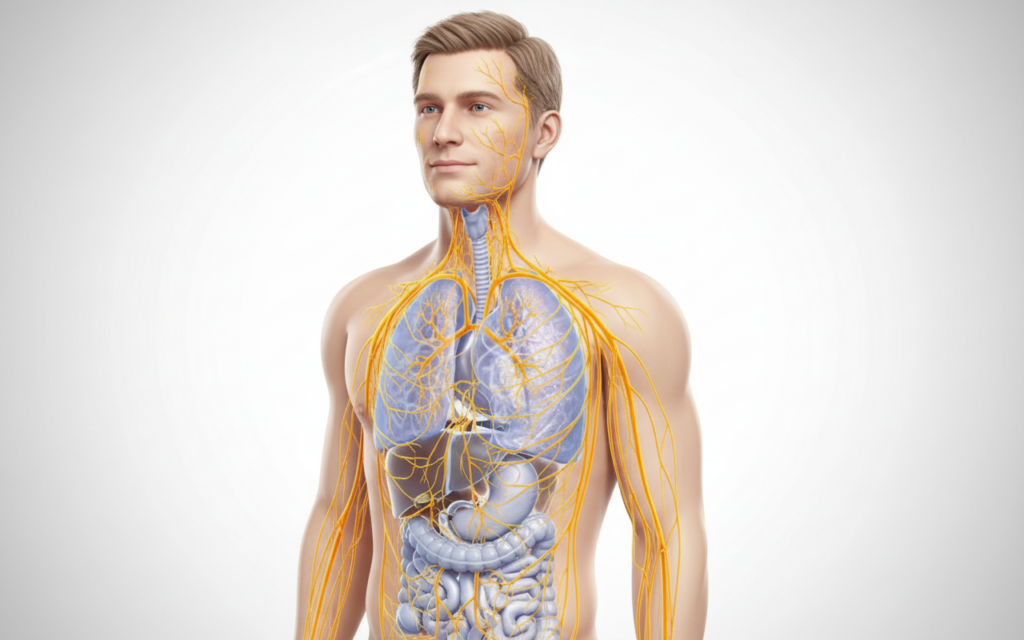
The vagus nerve is one of the most fascinating nerves in our body and plays a central role in our wellbeing. As the longest cranial nerve, it connects the brain with almost all vital organs and influences both our mental health and our physical functions. Particularly remarkable is its influence on stress regulation and digestion – two areas that often become imbalanced in our hectic everyday lives. In this article, you will learn how the vagus nerve functions and how you can specifically activate it to find inner calm and optimize your digestion.
What is the vagus nerve?
The vagus nerve, also referred to as the tenth cranial nerve or nervus vagus, is the longest and most complex of all twelve cranial nerves. Its name derives from the Latin word “vagus,” which means “wandering” – an apt description for this widely branched nerve that originates from the brainstem and extends into the abdominal cavity.
The vagus nerve is a mixed nerve that contains both sensory and motor fibers. About 80 percent of its fibers are afferent, meaning they transmit information from the organs to the brain. The remaining 20 percent are efferent fibers that transport signals from the brain to the organs. This bidirectional communication makes the vagus nerve an important information highway between body and brain.
These afferent fibers primarily transmit information about the state of internal organs (so-called interoception).
Anatomical course and branches
The vagus nerve originates in the brainstem, more precisely in the medulla oblongata, and exits the skull through the jugular foramen. From there, it branches into numerous divisions that supply various body regions. It innervates the larynx, pharynx, heart, lungs, esophagus, stomach, pancreas, liver, and most of the intestine up to the transverse colon. The remaining large intestine is supplied by the sacral parasympathetic nervous system.
This extensive distribution explains why the vagus nerve is involved in so many different bodily functions – from voice production to heart rate to intestinal movement.
The role in the parasympathetic nervous system
The vagus nerve is the most important component of the parasympathetic nervous system, often referred to as the “rest nerve” or “relaxation nerve.” It forms the counterbalance to the sympathetic nervous system, which is responsible for the stress response.
While the sympathetic nervous system puts the body on high alert – it increases heart rate, dilates pupils, and inhibits digestion – the parasympathetic nervous system does exactly the opposite. It slows the heartbeat, promotes digestion, and supports regeneration and repair processes in the body.
Vagal tone: A measure of health
The term “vagal tone” describes the activity of the vagus nerve. A high vagal tone indicates good vagal activity and is associated with numerous health benefits: better mood, fewer inflammations, more stable blood sugar, lower blood pressure, and more efficient digestion.
Low vagal tone, on the other hand, is associated with various health problems, including chronic inflammation, depression, anxiety, digestive disorders, and cardiovascular diseases. The good news: vagal tone is not set in stone but can be improved through targeted measures.
The vagus nerve and inner calm
The ability of the vagus nerve to calm and relax us is particularly significant in our stress-filled times. Chronic stress puts the body in a permanent state of alarm, in which the sympathetic nervous system is overactive. This can lead to sleep disorders, anxiety, elevated blood pressure, and a weakened immune system.
Stress regulation through vagal activation
An active vagus nerve acts like a natural brake on the stress response. It sends calming signals to the heart, lungs, and other organs and helps the body transition from a state of tension to a state of relaxation. This transition is crucial for stress management and emotional regulation.
Scientific studies have shown that people with higher vagal tone can handle stress better, are more emotionally resilient, and have a more positive basic mood. They recover more quickly from stressful events and show fewer symptoms of anxiety and depression.
The connection to heart rate variability
An important indicator of vagal activity is heart rate variability (HRV). This measures the variation in time intervals between consecutive heartbeats. High HRV indicates good vagal tone and is considered a sign of health and adaptability.
The vagus nerve influences HRV by constantly adjusting heart rate to the body’s current needs. During inhalation, vagal activity is slightly reduced and the heart beats somewhat faster; during exhalation, vagal activity increases and the heart slows down. This natural variation is a sign of a healthy, flexible system.
The vagus nerve and digestion
Digestion is one of the most important functions controlled by the vagus nerve. In fact, the connection between brain and gut via the vagus nerve is so significant that scientists speak of the “gut-brain axis.”
Control of digestive processes
The vagus nerve activates the entire digestive tract. It stimulates the production of digestive juices and enzymes in the stomach and pancreas, promotes intestinal movement (peristalsis), and supports the absorption of nutrients. Without sufficient vagal activity, digestion can become sluggish, which can lead to constipation, bloating, and other complaints.
Particularly interesting is the role of the vagus nerve in regulating appetite and satiety. It transmits information about the stomach’s fill level to the brain and thus influences our eating behavior. Well-functioning vagal communication helps us perceive natural hunger and satiety signals.
The vagus nerve and the gut microbiome
Recent research shows that the vagus nerve also communicates with our gut microbiome – the trillions of bacteria in our intestine. These microorganisms produce messenger substances that are transmitted to the brain via the vagus nerve and can influence our mood, immune system, and even our cognitive functions.
This reciprocal relationship is one of the reasons why digestive problems often accompany psychological complaints and vice versa (for example, in irritable bowel syndrome). Stress can impair gut health, while intestinal problems can worsen anxiety and depression.
Methods for activating the vagus nerve
The good news is that we can actively stimulate the vagus nerve and improve its tone. There are numerous evidence-based methods that can be easily integrated into daily life.
Breathing techniques
Deep, slow breathing is one of the most effective methods for vagal activation. Particularly effective is prolonged exhalation, as the vagus nerve is especially active during exhalation. A proven technique is 4-7-8 breathing: inhale for four seconds, hold your breath for seven seconds, exhale for eight seconds. This method activates the parasympathetic nervous system and promotes relaxation. This technique should initially be practiced for only a few rounds, as it can cause dizziness in untrained individuals.
Cold exposure
Cold stimuli, such as cold water on the face or cold showers, can stimulate the vagus nerve. This method activates the so-called “dive reflex,” in which the body automatically switches to relaxation mode to conserve energy. Even 30 seconds of cold water at the end of a shower can have a noticeable effect.
People with cardiovascular diseases should discuss cold applications with their doctor beforehand, as the cold stimulus can also temporarily increase blood pressure.
Singing and humming
Since the vagus nerve innervates the larynx, singing, humming, or reading aloud can mechanically stimulate the nerve. These activities create vibrations in the throat area that are directly transmitted to the vagus nerve. Gargling with water can also have a similar effect.
Meditation and mindfulness
Regular meditation and mindfulness practices demonstrably increase vagal tone. According to studies, loving-kindness meditation (metta meditation) appears to be particularly effective, as it cultivates positive emotions and can increase vagal activity. As little as 10 to 20 minutes of daily practice can produce long-term improvements.
Physical movement
Moderate physical activity, particularly endurance sports such as jogging, swimming, or cycling, improves vagal tone. Yoga also combines movement with conscious breathing and relaxation and is therefore particularly effective for vagal stimulation.
Social connections
Positive social interactions and warm relationships activate the vagus nerve. Laughing, hugging, and meaningful conversations promote parasympathetic activity and contribute to higher vagal tone. This social component underscores how important interpersonal relationships are for our health.
Probiotics and nutrition
A gut-healthy diet with sufficient fiber and fermented foods supports the microbiome and thus indirectly also vagus nerve function. Probiotic foods such as yogurt, kefir, sauerkraut, and kimchi can indirectly positively influence gut-brain communication by supporting the gut microbiome.
Vagus nerve stimulation in medicine
In addition to these natural methods, there are also medical procedures for vagus nerve stimulation (VNS). A small device similar to a pacemaker is implanted that sends electrical impulses to the vagus nerve. This therapy is successfully used for treatment-resistant epilepsy and also shows positive effects in severe, treatment-resistant depression, where it is typically used as an adjunct therapy.
Recent developments also include non-invasive VNS devices that stimulate the vagus nerve through the skin, such as on the ear (transcutaneous auricular VNS) or on the neck. These methods are still largely under investigation; initial studies show promising but yet-to-be-confirmed results.
Signs of weak vagal tone
Low vagal tone can manifest itself in various ways. Common symptoms include chronic digestive problems such as constipation or irritable bowel syndrome, difficulties with stress relief, increased susceptibility to inflammation, difficulties with blood pressure regulation (e.g., dizziness when standing up), chronic fatigue, and emotional instability.
Low heart rate variability, which can be measured with special devices or apps, can also indicate weak vagal tone. If you notice several of these symptoms in yourself, it may be useful to work specifically on improving your vagal tone and, if necessary, seek medical advice.
Conclusion: The vagus nerve as a key to health and wellbeing
The vagus nerve is far more than just an anatomical detail – it is a central player in our physical and mental health. Its role as mediator between brain and body makes it a key factor for inner calm, stress regulation, and healthy digestion. The diverse connections to heart, lungs, stomach, and intestines show how interconnected our body works and how important a well-functioning vagus nerve is for our overall wellbeing.
The good news is that we can actively influence our vagal tone. Through simple, everyday methods such as conscious breathing, cold applications, meditation, movement, and social contacts, we can strengthen this important nerve and benefit from its numerous positive effects. It’s not about implementing all methods simultaneously, but rather about finding those that fit your individual lifestyle and can be integrated long-term.
Whether you suffer from chronic stress, want to improve your digestion, or simply wish to increase your general wellbeing – activating the vagus nerve offers a scientifically founded approach that comes without side effects and is placed in your own hands. Start today by giving your vagus nerve the attention it deserves, and experience how inner calm and physical wellbeing can develop positively.
Dieser Ratgeber dient ausschließlich zu Informationszwecken und ersetzt keine medizinische Beratung oder Diagnose. Bei anhaltenden Beschwerden konsultieren Sie bitte einen Arzt. Nahrungsergänzungsmittel und Heilpflanzen sollten nicht ohne Rücksprache mit einem Therapeuten eingenommen werden.