
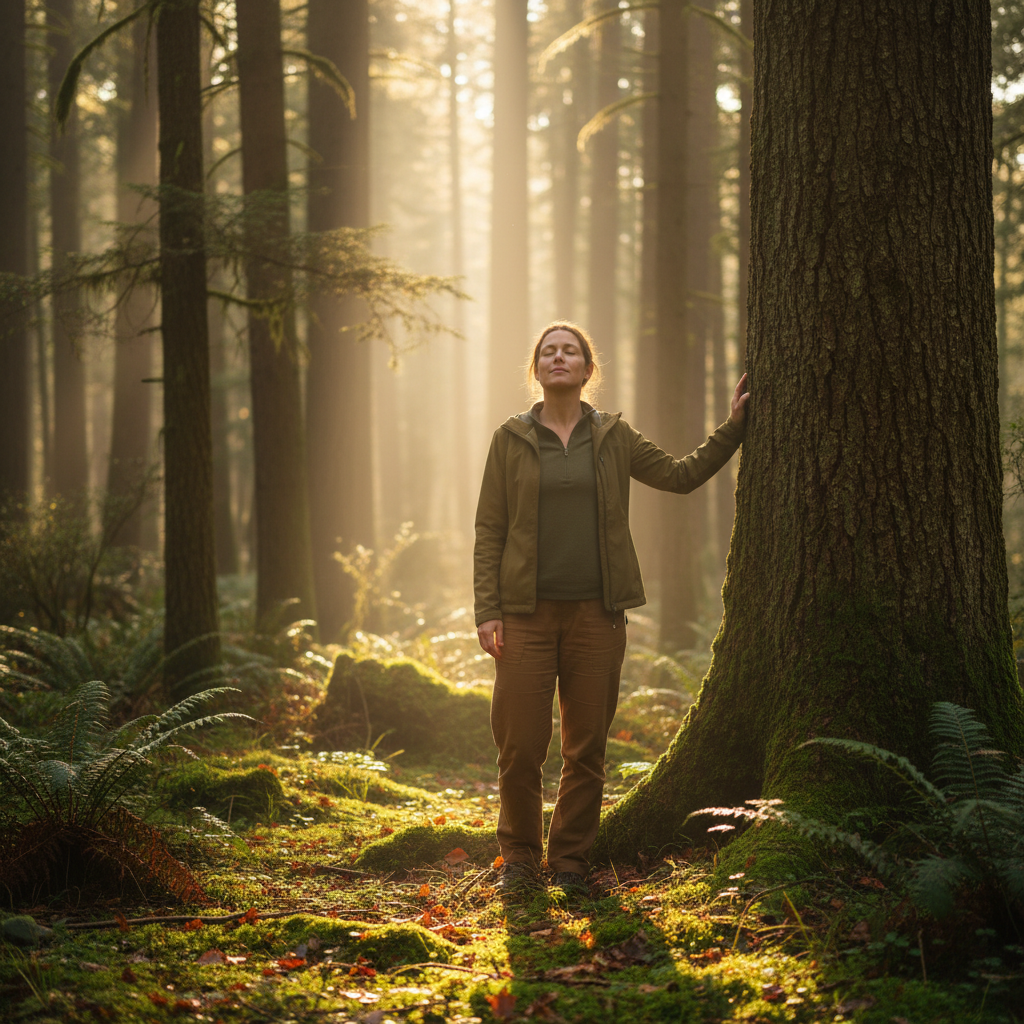
In our hectic, digitalized world, more and more people long for natural peace and relaxation. The Japanese practice of Shinrin-yoku – “forest bathing” in English – offers exactly that: a scientifically based method to heal body and mind through conscious immersion in the forest atmosphere. Particularly impressive are the measurable effects on our nervous system, which go far beyond a mere feeling of well-being.
Shinrin-yoku was developed in Japan in the 1980s as an official health prevention program and is today an integral part of Japanese preventive medicine. Meanwhile, numerous international studies confirm the healing effects of forest bathing on our physical and mental health – especially on our often overburdened nervous system.
What Exactly Is Shinrin-yoku?
Forest bathing does not mean actually bathing in a body of water. Rather, it is about consciously and mindfully immersing yourself in the atmosphere of the forest. It is a meditative practice in which all senses are opened to fully absorb the healing forest environment.
Unlike athletic activities such as jogging or mountain biking, forest bathing does not focus on physical performance. The practice is characterized by slowness, mindfulness, and conscious perception. A typical forest bath lasts two to four hours, during which often only a few kilometers are covered.
The Basic Principles of Forest Bathing
Authentic Shinrin-yoku involves several central elements: consciously breathing the forest-rich air, mindfully perceiving sounds, scents, and visual impressions, as well as slowing down from everyday pace. Smartphones remain switched off, performance thoughts are let go. Instead, the connection to nature and to oneself is at the center.
This form of nature therapy requires no special equipment or prior knowledge. Any forest – whether mixed forest, coniferous forest, or deciduous forest – is fundamentally suitable for the practice. Only the inner attitude is important: to be open, curious, and present.
How Forest Bathing Affects Our Nervous System
Our nervous system consists of two main components: the sympathetic and parasympathetic nervous systems. The sympathetic system activates us, puts us on alert, and is responsible for the stress response – helpful in real danger situations, problematic with chronic activation. The parasympathetic system, on the other hand, is responsible for recovery, regeneration, and healing.
Modern living conditions with constant availability, noise, artificial light, and psychological pressure lead to permanent overstimulation of the sympathetic system in many people. This chronic stress activation is associated with numerous health problems: high blood pressure, sleep disorders, digestive problems, weakened immune system, and increased risk of mental illness.
The Measurable Stress Reduction Through Forest Visits
Scientific studies impressively show how even short forest visits positively influence the autonomic nervous system. In a Japanese study with 280 participants, it was demonstrated that a 15-minute forest visit significantly lowers cortisol levels – our main stress hormone.
Heart rate variability, an important indicator of our nervous system’s flexibility, noticeably improves during forest bathing. Higher heart rate variability shows that our autonomic nervous system can respond flexibly and adaptably – a sign of a healthy, adaptable nervous system.
At the same time, activity in the prefrontal cortex decreases, the brain area responsible for analytical thinking and rumination. This explains why many people feel mentally refreshed and freed from circling thoughts after a forest visit.
Phytoncides: The Healing Messenger Substances of Trees
A fascinating aspect of forest bathing is the so-called phytoncides – natural essential oils that trees and plants release to ward off pests and pathogens. When we walk through the forest, we breathe in these substances, which have measurable effects on our body.
Coniferous trees such as pines, spruces, and firs in particular produce large amounts of these terpenes. Studies show that these plant compounds strengthen our immune system by increasing the number and activity of natural killer cells – important components of our immune defense against viruses and tumor cells.
Long-Lasting Immune Strengthening
Particularly impressive: the positive effects on the immune system last surprisingly long. Individual studies showed that after a two-day forest stay, the number of natural killer cells was still elevated 30 days later. This suggests that regular forest visits can bring about a sustainable strengthening of our defenses.
The phytoncides also have a relaxing effect on our nervous system. They activate the parasympathetic branch, promote the release of calming neurotransmitters, and thus contribute to stress reduction – a perfect interplay between nature and human physiology.
Concrete Health Benefits for the Nervous System
The regular practice of forest bathing shows diverse positive effects on our nervous system and the associated bodily functions. These are not only subjectively noticeable but also objectively measurable.
Blood Pressure Reduction and Heart Health
Several studies prove that forest bathing leads to a significant reduction in blood pressure – both systolic and diastolic values. This is particularly relevant for people with hypertension or increased risk of cardiovascular diseases. The relaxation of the nervous system leads to a dilation of blood vessels and thus to a relief of the entire circulatory system.
Heart rate decreases during and after forest bathing, which indicates increased activity of the calming parasympathetic system. At the same time, blood circulation improves, and the body can regenerate better.
Improvement in Sleep Quality
An overstimulated nervous system is a common cause of sleep problems. Forest bathing helps regulate the autonomic nervous system and facilitate the transition to relaxation mode. People who regularly practice forest bathing report better falling asleep, deeper sleep, and more restful nights.
Spending time outdoors and the natural light rhythms support our circadian rhythm – the internal biological clock that controls our sleep-wake cycle.
Reduction of Anxiety and Depression
The calming effect on the nervous system makes forest bathing a valuable complementary therapy for anxiety disorders and depression. The natural environment reduces activity in the amygdala – the fear center of our brain – while simultaneously promoting the release of serotonin and dopamine, our natural mood enhancers.
In a Korean study, participants with diagnosed depression showed significant improvements in their symptoms after a forest therapy program, in addition to conventional treatment. The combination of physical movement, sensory experience, and the calming forest atmosphere proved particularly effective.
Practical Guide: How to Practice Forest Bathing Correctly
To optimally utilize the healing effects of forest bathing, no complicated techniques are required. Nevertheless, there are some recommendations that can deepen your practice.
The Right Preparation
Choose a quiet forest area that you can visit without time pressure. Plan at least two hours, ideally three to four. Dress appropriately for the weather and comfortably. Turn off your smartphone or put it in airplane mode – availability is the enemy of relaxation.
You don’t need a destination or a route. Let yourself be guided by your intuition and go where you feel drawn. It’s not about kilometers covered, but about the quality of the experience.
Activate the Five Senses
Consciously open all your senses: Observe the different shades of green, the play of light between the leaves, the texture of tree bark. Listen to the bird songs, the rustling of leaves, the cracking of twigs under your feet. Smell the earthy, resinous, fresh scents of the forest.
Feel different textures: moss, bark, leaves, earth. If you like and it’s safe, taste edible forest fruits like berries – the sense of taste completes the sensory experience.
Breathing Exercises and Mindfulness
Consciously slow down your breath. Breathe deeply into your belly, pause briefly, and exhale slowly. This simple breathing technique directly activates the calming parasympathetic system. Notice how the forest-rich air flows into your body.
When thoughts arise, let them pass like clouds. Keep returning to your sensory perceptions. This mindfulness practice enhances nervous system regeneration.
Regularity Is Crucial
As with any health-promoting practice, the key lies in regularity. Forest bathing once a week for two to three hours already shows clear effects. Additionally, shorter stays of 20 to 30 minutes on other days can also be helpful.
Different seasons offer different experiences. The winter forest with its silence, the spring forest with its awakening, the summer forest with its abundance, and the autumn forest with its colors – each phase has its own healing quality.
Scientific Evidence and Research
The health effects of forest bathing are now supported by numerous scientific studies. Particularly Japanese and South Korean research institutions have conducted extensive investigations.
Professor Yoshifumi Miyazaki from Chiba University in Japan is considered a pioneer of forest medicine research. His studies using imaging techniques show the direct effects of forest stays on brain activity. Dr. Qing Li from Nippon Medical School in Tokyo has particularly researched and documented the immune-strengthening effects.
In Europe and North America, the topic is gaining increasing importance. Universities in Germany, Austria, and Switzerland are investigating the applicability of forest therapy in prevention and rehabilitation. Initial health insurance companies recognize the preventive value and support corresponding programs.
Integrating Forest Bathing into Everyday Life
Even though extended forest walks are ideal, the principles of forest bathing can also be integrated into urban everyday life. City parks with old tree populations also offer healing nature experiences, albeit to a lesser extent than dense forests.
Use breaks for short stays in green spaces. Even ten minutes of conscious sitting under a tree can calm the nervous system. Make sure to really be present – not checking your smartphone on the side.
Create green retreats in your own living environment if possible. Houseplants, especially large-leaved varieties, can contribute to air humidity and bring a piece of nature into your daily environment.
Conclusion: The Forest as a Natural Remedy for the Nervous System
Shinrin-yoku is far more than a wellness trend – it is a scientifically based practice with measurable health benefits. The forest’s ability to calm our overstimulated nervous system, strengthen the immune system, and promote mental health is impressive and supported by numerous studies.
In a time when chronic stress is among the greatest health risks, forest bathing offers a simple, cost-effective, and side-effect-free way (when observing safety aspects such as tick protection) to promote health and restore inner balance. The activation of the parasympathetic nervous system, the reduction of stress hormones, and the strengthening of immune defense are just some of the documented effects.
The forest is available to us as a natural pharmacy – we just need to learn to consciously use its healing power. Forest bathing requires no special fitness, no expensive equipment, and no complicated techniques. It only demands time, mindfulness, and the willingness to engage with nature.
Start your own forest bathing practice today. Your nervous system, your immune system, and your overall health will thank you. In the silence of the forest, you will find not only peace but also a deep form of healing that perfectly complements our modern medicine.
Dieser Ratgeber dient ausschließlich zu Informationszwecken und ersetzt keine medizinische Beratung oder Diagnose. Bei anhaltenden Beschwerden konsultieren Sie bitte einen Arzt. Nahrungsergänzungsmittel und Heilpflanzen sollten nicht ohne Rücksprache mit einem Therapeuten eingenommen werden.