
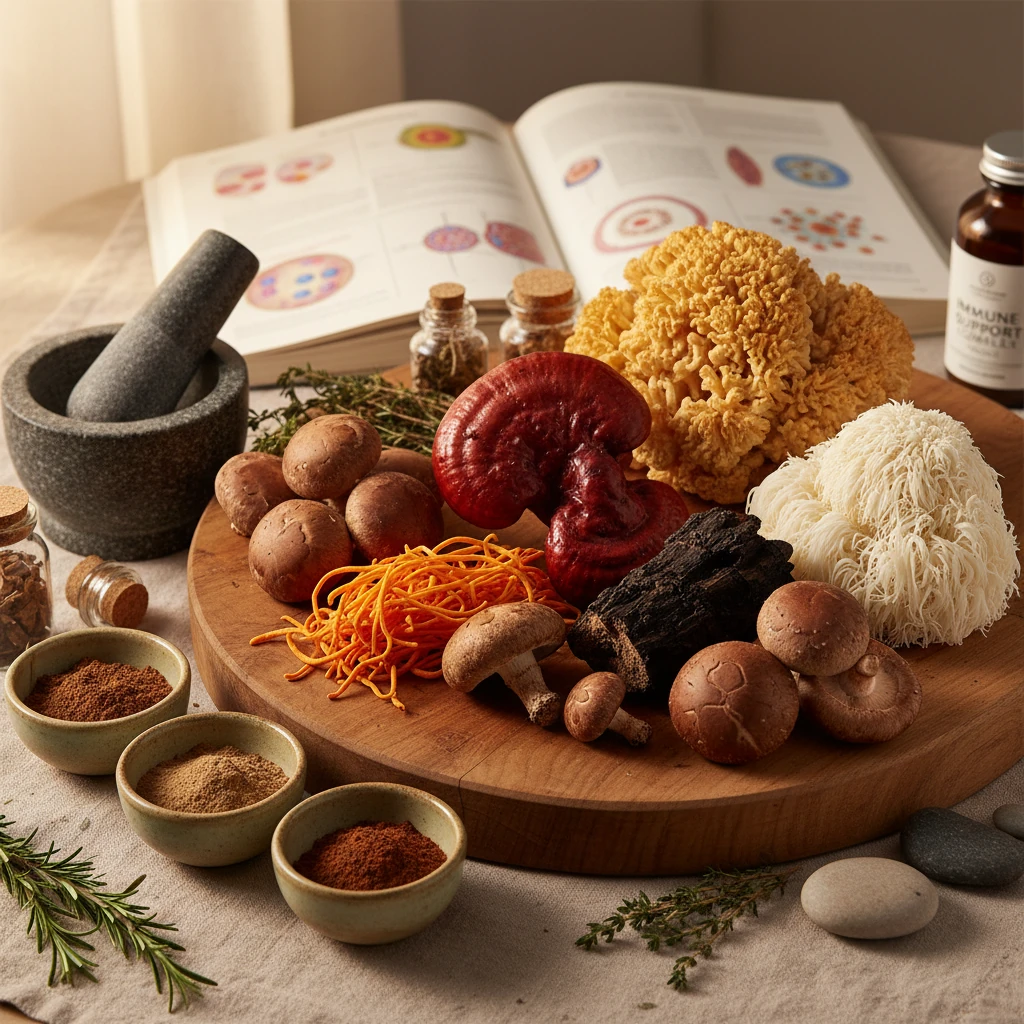
In traditional Chinese and Japanese medicine, medicinal mushrooms have been used for centuries to strengthen the immune system and treat various ailments. What has long been part of everyday medical practice in Asia is now gaining increasing importance in the Western world. Medicinal mushrooms such as Reishi, Cordyceps, Shiitake and many others are not only culinary delicacies, but can also be valuable allies for your immune system. In this article, you’ll learn everything worth knowing about the most important medicinal mushrooms, how they work and how you can optimally use them for your health.
What makes medicinal mushrooms so special?
Medicinal mushrooms are characterized by their unique composition of bioactive substances. Unlike ordinary edible mushrooms, they contain particularly high concentrations of valuable ingredients that can have a positive effect on your health. The most important active compounds include beta-glucans, polysaccharides, triterpenes, ergosterol and various antioxidants.
Beta-glucans play a central role in supporting the immune system. These complex sugar molecules can activate various immune cells such as macrophages, natural killer cells and T-lymphocytes. This can enable your body to better recognize and fight pathogens. At the same time, many medicinal mushrooms have adaptogenic properties, meaning they can help your body cope better with stress and support inner balance.
Reishi – the mushroom of immortality
The Reishi mushroom, scientifically known as Ganoderma lucidum, bears the reverent name “Ling Zhi” in China, which means something like “spirit mushroom” or “mushroom of immortality”. This shiny, reddish-brown mushroom with its characteristic kidney-shaped growth form is one of the most well-researched medicinal mushrooms of all.
Effect on the immune system
Reishi contains over 400 bioactive substances, with polysaccharides and triterpenes being particularly noteworthy. These active compounds can modulate your immune system in an intelligent way: they can strengthen it when weak and regulate it during excessive reactions such as allergies. Studies show that Reishi can stimulate the production of immune cells and increase the activity of natural killer cells, which are responsible for defending against viruses and abnormal cells.
Other health benefits
In addition to its immunomodulating effect, Reishi has pronounced antioxidant properties. It can protect your cells from free radicals and thereby counteract oxidative stress. Furthermore, Reishi is traditionally used to support liver function, promote healthy sleep and reduce stress. Many users report improved sleep quality and a generally increased sense of well-being.
Cordyceps – the energy mushroom from the Himalayas
The Cordyceps mushroom, particularly Cordyceps sinensis and Cordyceps militaris, has a fascinating lifestyle and can have an impressive effect on the human organism. In the wild, this mushroom grows as a parasite on certain insect larvae in the high altitudes of the Himalayas and Tibet, making it one of the most expensive natural products in the world. For therapeutic purposes, it is now mostly cultivated on plant-based nutrient substrates.
Immune-strengthening properties
Cordyceps contains special polysaccharides and adenosine derivatives such as cordycepin, which can have an immunomodulating effect. They can activate macrophages and increase the production of natural killer cells. Particularly remarkable is Cordyceps’ ability to improve the cellular immune response, which can be especially important in defending against intracellular pathogens.
Energy and endurance
Cordyceps is particularly known for its potentially energy-boosting effect. It can improve oxygen uptake in cells and optimize ATP production in the mitochondria – the powerhouses of your cells. Athletes value Cordyceps for potentially increasing endurance performance and shortening recovery time. Cordyceps can also provide support for chronic fatigue and exhaustion.
Shiitake – the king of edible mushrooms with healing properties
The Shiitake mushroom (Lentinula edodes) may already be familiar to you from the kitchen. But this aromatic mushroom is far more than just a culinary ingredient. In traditional Asian medicine, Shiitake has been valued as a remedy for centuries and has been intensively researched scientifically.
Lentinan – the immune booster
The most important active ingredient in Shiitake is probably lentinan, a beta-glucan with immunostimulating properties. Lentinan can activate various components of your immune system, including T-helper cells, cytotoxic T-cells and macrophages. In Japan, a highly purified lentinan preparation is used as an adjunct cancer therapy.
Support for cardiovascular health
Shiitake contains eritadenin, a substance that can have a positive effect on your cholesterol levels. Studies show that regular consumption of Shiitake can help lower LDL cholesterol while increasing HDL cholesterol. Additionally, Shiitake has anti-inflammatory properties and can thereby help reduce the risk of cardiovascular disease.
Other important medicinal mushrooms for your immune system
Maitake – the dancing mushroom
Maitake (Grifola frondosa) is also called “hen of the woods”. Its name means “dancing mushroom”, which refers to the joy of collectors when finding this valuable mushroom. Maitake is rich in D-fraction, a special beta-glucan that can activate the immune system. This mushroom is frequently used to support blood sugar regulation and weight management.
Chaga – the black gold of the forests
The Chaga mushroom (Inonotus obliquus) grows primarily on birch trees in cold climates. It looks more like charred wood than a typical mushroom. Chaga is exceptionally rich in antioxidants and has one of the highest ORAC values (Oxygen Radical Absorbance Capacity) of all natural foods. It can support your immune system and protect your cells from oxidative stress and premature aging.
Hericium – the lion’s mane
Hericium erinaceus, also known as lion’s mane, is characterized by its particular affinity for the nervous system. In addition to immune-strengthening properties, this mushroom contains substances that can stimulate the production of nerve growth factor (NGF). Hericium is therefore particularly valued for supporting cognitive functions and gut health.
How to use medicinal mushrooms correctly
Forms of administration
Medicinal mushrooms are available in various forms. Powder from the dried and ground fruiting body or mycelium is particularly popular, as it contains all ingredients in their natural form. Extracts offer the advantage of higher active ingredient concentrations, especially when they have been dual extracted – meaning with both water and alcohol to obtain both water-soluble and fat-soluble active compounds.
Capsules are practical for daily intake and allow precise dosing. Teas and tinctures are other options, although it should be noted with teas that not all active compounds are water-soluble. Some mushrooms like Shiitake and Maitake can also be consumed fresh or dried as edible mushrooms, although you would need to consume larger quantities than with concentrated preparations to achieve therapeutic effects.
Dosage and intake
The optimal dosage depends on various factors, including the mushroom used, the form of administration and your individual health condition. As a general guideline, approximately 1–3 grams daily for powder, and correspondingly less for extracts due to their higher concentration. It is recommended to start with a lower dose and gradually increase it to test tolerability.
For optimal results, you should take medicinal mushrooms regularly over a longer period, ideally at least 8–12 weeks. Many experts recommend taking them with meals to improve tolerability. With several different medicinal mushrooms, you can take them either individually in rotation or as a combination.
Quality and selection – what you should pay attention to
The quality of medicinal mushroom preparations can vary considerably. Make sure that the product is made from the fruiting body, as it generally contains higher concentrations of bioactive substances than pure mycelium. Organic quality is recommended to avoid contamination with pollutants.
Reputable manufacturers have their products tested by independent laboratories for purity and active ingredient content and provide corresponding analysis certificates. The beta-glucan content should be declared, as these are considered the main active compounds. Ideally, at least 20–30% polysaccharides should be contained. Avoid products with unnecessary additives, fillers or artificial flavors.
Possible side effects and interactions
Medicinal mushrooms are generally considered very safe and well-tolerated. Occasionally, mild digestive discomfort may occur at the beginning of intake, which usually subsides after a short time. In rare cases, allergic reactions are possible, especially if you already react allergically to other mushrooms.
If you are taking blood-thinning medications, you should consult your doctor before using Reishi or Maitake, as these can affect blood clotting. For autoimmune diseases, medical consultation is important, as immunomodulating substances can influence disease activity. Pregnant and breastfeeding women should avoid medicinal mushroom preparations, as there is insufficient data on safety during this time.
Scientific evidence – what does the research say?
Scientific research on medicinal mushrooms has increased significantly in recent decades. Numerous studies, including clinical investigations, confirm the immunomodulating properties of various medicinal mushrooms. The effects of Reishi, Shiitake and Cordyceps are particularly well-researched.
Studies show that medicinal mushrooms can increase the activity of various immune cells. Other investigations demonstrate antioxidant, anti-inflammatory and adaptogenic properties. However, it should be noted that many studies have been conducted in the laboratory or on animals. Further clinical studies on humans are desirable to better understand the therapeutic potential and refine dosage recommendations.
Integration into your daily life
Medicinal mushrooms can be integrated into your daily life in various ways. You can incorporate Shiitake and Maitake as tasty ingredients in your diet – in soups, stir-fries or as a side dish. However, for a therapeutic effect, extracts or concentrated preparations are more effective.
Many people appreciate a morning routine with medicinal mushroom tea or a smoothie with mushroom powder. Combinations with other immune-strengthening substances such as ginger, turmeric or vitamin C can have synergistic effects. Regularity is important – medicinal mushrooms only develop their full effect with continuous use over several weeks to months.
Conclusion: Medicinal mushrooms as natural immune support
Medicinal mushrooms such as Reishi, Cordyceps, Shiitake and many others offer you a natural and holistic way to support your immune system and promote your overall health. Their centuries-long use in traditional medicine is increasingly being confirmed by modern scientific research. The unique combination of beta-glucans, polysaccharides and other bioactive substances makes medicinal mushrooms valuable allies for your health.
Whether you want to strengthen your defenses, boost your energy or simply do something preventively for your health – medicinal mushrooms can be a sensible supplement to a healthy lifestyle. Pay attention to high-quality products, start with an appropriate dosage and give your body time to respond to the natural active ingredients. If you have existing illnesses or are taking medication, you should consult your doctor before use. With the right selection and application, medicinal mushrooms can make a valuable contribution to your well-being and health.
Dieser Ratgeber dient ausschließlich zu Informationszwecken und ersetzt keine medizinische Beratung oder Diagnose. Bei anhaltenden Beschwerden konsultieren Sie bitte einen Arzt. Nahrungsergänzungsmittel und Heilpflanzen sollten nicht ohne Rücksprache mit einem Therapeuten eingenommen werden.