
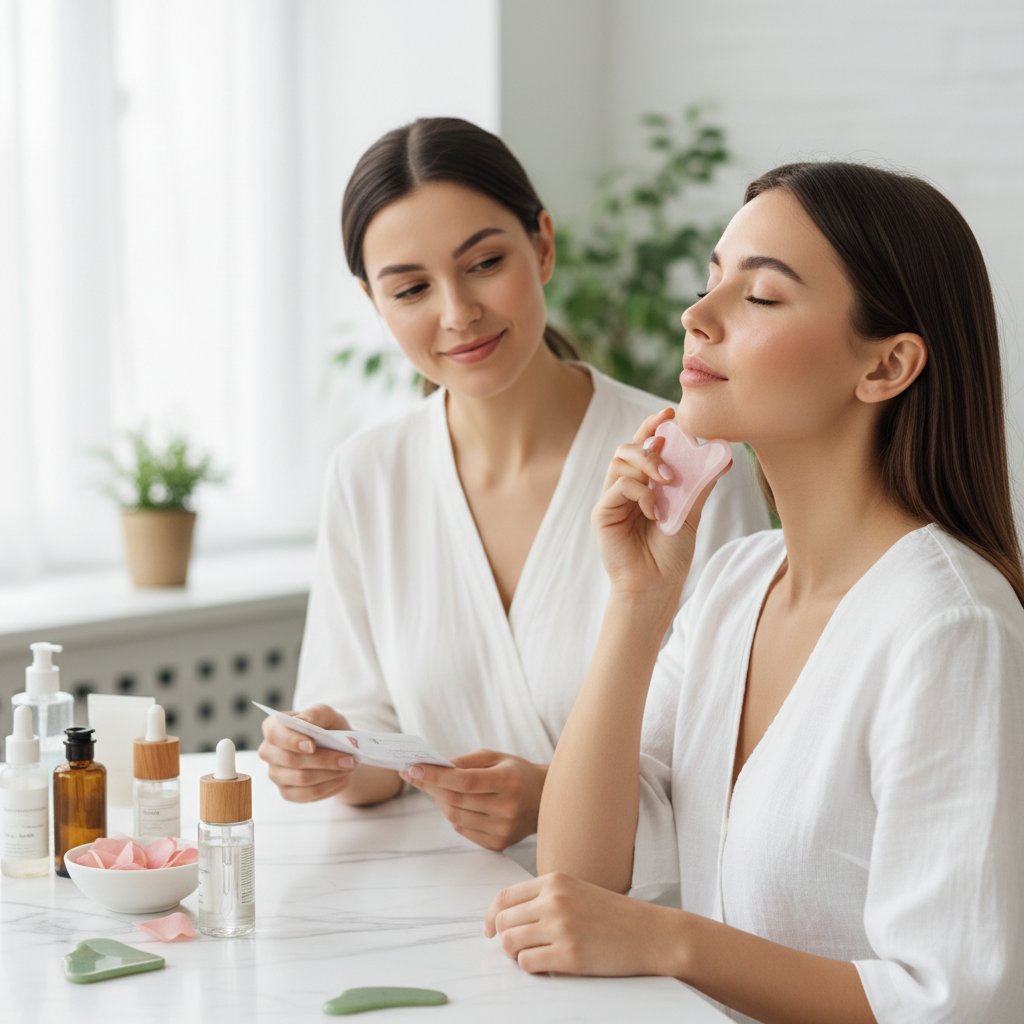
Gua Sha is taking the beauty world by storm – and for good reason. The centuries-old Chinese massage technique promises firmer skin, a more even complexion and a natural lifting effect, all without invasive procedures. What may initially sound like just another beauty trend is actually based on a traditional healing method that has been used for generations in Traditional Chinese Medicine (TCM). For beginners, getting started with this facial massage can seem overwhelming at first, but with the right guidance, this lifting ritual can be easily integrated into your daily skincare routine. In this comprehensive guide, you’ll learn everything you need to know about Gua Sha – from choosing the right stone to the perfect technique for radiant, rejuvenated skin.
What is Gua Sha and where does this technique come from?
The term “Gua Sha” comes from Chinese and is composed of “Gua” (scraping or stroking) and “Sha” (redness or stagnation). Originally, this method was used in TCM to release blockages in the body’s energy flow, known as Qi, and to promote circulation. While traditional Gua Sha is practiced on the entire body with firmer stroking movements to relieve muscle tension and pain, the facial application has evolved into a much gentler variation.
In facial Gua Sha massage, specially smoothed stones are used to glide gently over the skin with soft stroking movements. Unlike body application, the goal here is not to create redness, but to stimulate lymphatic drainage, improve circulation and relax the facial muscles. This modern interpretation has made Gua Sha a popular tool in anti-aging skincare.
The scientific foundations: How Gua Sha affects the skin
The positive effects of Gua Sha on facial skin can be explained by various physiological mechanisms. During the massage, several processes are stimulated in the tissue, which together are responsible for the characteristic “glow” and lifting effect.
Lymphatic drainage and detoxification
The lymphatic system plays a central role in removing metabolic products and metabolic waste products. Important lymphatic pathways run through the face, which can be activated through gentle massage movements. Gua Sha supports lymph flow, which reduces swelling, removes water retention and supports lymph flow. The result: a more defined facial profile and less puffiness, especially under the eyes.
Improved circulation
The stroking movements of the Gua Sha stone promote microcirculation in the fine blood vessels of the skin. Better circulation means more oxygen and nutrients for the skin cells, which leads to a rosy, healthy complexion. At the same time, metabolic products are transported away more efficiently, which supports skin regeneration.
Relaxation of facial muscles
Many people unconsciously carry tension in their facial muscles – for example, through teeth grinding, concentrated work or stress. These muscular tensions can contribute to wrinkle formation and a tired appearance. Gua Sha helps to release these tensions, relax the muscles and thereby reduce fine lines.
Promotion of collagen production
It is suspected that regular facial massages could stimulate fibroblast activity – those cells responsible for the production of collagen and elastin. However, the research on this is still limited. These proteins are essential for the firmness and elasticity of the skin. Although Gua Sha cannot stop natural skin aging, the method helps to strengthen skin structure and maintain elasticity.
Choosing the right Gua Sha stone
Gua Sha stones are available in various materials, shapes and sizes. Choosing the right stone can make a difference in your application experience.
Popular stone materials
Rose quartz is one of the most popular materials for Gua Sha stones. It feels pleasant on the skin. In crystal healing, it is attributed a calming effect, although this is not scientifically proven. Jade, especially the green variety, is the traditional material from Chinese practice and stays cool longer, which has an additional decongestant effect. Amethyst is said to have calming properties and is particularly suitable for sensitive skin. Obsidian and black jade are also used, but are less common.
From a scientific perspective, the material plays a subordinate role – the technique and regular application are more crucial than the esoteric properties of the stones. What’s important is that the stone is smoothly polished, has no sharp edges and feels comfortable on your skin.
Shape and ergonomics
Most Gua Sha stones have a heart-shaped or rectangular form with different edges and curves. These are designed for different facial areas: The long, flat edge is suitable for larger areas such as cheeks and forehead, the serrated areas for massages along the jawline, and the smaller curves for precise work around eyes and nose. When purchasing, make sure that the stone fits well in your hand and that you can reach all areas of your face with it.
Proper preparation: How to prepare your skin
Thorough preparation is crucial for an effective and pleasant Gua Sha application. Always start with a clean face – makeup residue or impurities can be pushed deeper into the pores through the massage.
After cleansing, the application of a facial oil or serum is essential. The Gua Sha stone should never be used on dry skin, as this can lead to friction, irritation and possibly even micro-injuries. A rich facial oil allows the stone to glide smoothly over the skin. Suitable options include jojoba oil, argan oil, rosehip oil or special facial serums with hyaluronic acid.
Apply a generous amount of oil or serum to face, neck and décolleté. The skin should be well moistened so that the stone glides effortlessly without pulling. Many users keep their Gua Sha stone in the refrigerator – the cooling effect enhances the decongestant effect, especially in the morning or for puffy eyes.
The Gua Sha technique for beginners: Step-by-step guide
The correct technique is crucial to achieve the desired results and not to stress the skin. Follow these basic principles for an effective Gua Sha massage.
Basic movement rules
All movements are always in one direction – from inside to outside and from bottom to top. This corresponds to the natural direction of the lymphatic pathways and supports drainage. Repeat each movement three to five times before moving on to the next area. The stone should be held at an angle of about 15 to 30 degrees to the skin, not lying flat. Apply gentle but noticeable pressure – it should be pleasant, not painful.
Neck and décolleté
Start at the neck to open the lymphatic pathways and prepare for drainage. Place the stone in the center of the neck just above the collarbone and stroke with gentle pressure sideways outward toward the shoulder. Repeat this three to five times on each side. Then stroke downward from the jaw along the side of the neck to the shoulder.
Jaw area and cheeks
Place the stone at the center of the chin and stroke along the jawline to the ear. This movement helps to define contours and release tension in the jaw area. For the cheeks, place the stone next to the nose and stroke toward the temple. Work your way up from the lower cheek area.
Eye area
The skin around the eyes is particularly thin and sensitive – use only minimal pressure here. Start at the inner corner of the eye and stroke gently below the eye along the bone to the temple. For the upper eye area, stroke from the inner corner of the eye over the movable lid to the eyebrow and further to the temple.
Forehead
Place the stone between the eyebrows and stroke horizontally to the temple. Repeat this movement at different heights of the forehead up to the hairline. This helps to smooth forehead wrinkles and relieve tension headaches.
Nose and nasolabial fold
With the smaller edge of the stone, you can stroke down the side of the nose and then work the nasolabial fold from the nose to the corners of the mouth. This movement is often neglected, but can contribute to tightening this problematic area.
Frequency and timing of application
For optimal results, regular application three to five times a week is recommended. A complete Gua Sha routine takes about five to ten minutes. Consistency is more important than duration – a short daily application brings better results than an intensive weekly treatment.
The ideal time is in the morning after cleansing to reduce swelling and prepare the skin for makeup, or in the evening as a relaxing ritual before bedtime. Many users integrate Gua Sha into their evening routine, as the relaxing effect can promote sleep.
Avoiding common mistakes
As a beginner, some mistakes can impair the effectiveness of the treatment or even be counterproductive. Too much pressure is one of the most common mistakes – Gua Sha should never be painful or leave bruises on the face. The movements should be gentle but firm.
Another mistake is the wrong direction of movement. Downward movements or back-and-forth rubbing can stretch the skin and hinder lymph flow. Stick strictly to upward and outward movements. Also, application on unprepared skin without sufficient gliding medium leads to friction and can irritate the skin.
Some users expect immediate, dramatic results. While a certain “glow” and relaxation are visible immediately after application, visible effects such as a firmer appearance and reduced fine lines only show after several weeks of regular application.
Care and hygiene of your Gua Sha stone
Proper care of the Gua Sha stone is important for hygiene and longevity of the tool. Clean the stone thoroughly after each use with mild soap and warm water to remove oil and product residue. Then dry it carefully with a soft cloth.
Once a week, you can additionally clean the stone with an alcohol-based disinfectant, especially if you are prone to skin blemishes. Store the stone in a clean bag or case to protect it from dust and damage. If cracks or chips appear, the stone should be replaced, as rough spots can injure the skin.
When to be careful: Contraindications
Although Gua Sha is safe for most people, there are some situations where you should avoid the application or discuss it with a doctor. For active skin conditions such as acne, rosacea, eczema or open wounds, you should avoid the affected areas or refrain from treatment altogether, as the massage can worsen inflammation. For very thin or irritated skin, you should be particularly gentle and possibly limit the application to 2-3 times per week.
People with blood clotting disorders or on blood-thinning medications should be careful, as the massage can theoretically cause bruising. After cosmetic procedures such as Botox or fillers, a waiting period of at least two weeks is recommended to avoid affecting the results. Consult your treating physician beforehand.
For very sensitive skin, you should start with particularly gentle pressure and observe your skin’s reaction. Pregnant women can usually perform the gentle facial application, but should consult their doctor as a precaution and avoid intensive body Gua Sha treatments (especially in the abdominal area).
Gua Sha in combination with other treatments
Gua Sha can be excellently integrated into a comprehensive skincare routine and can even enhance the effectiveness of other products. The massage can support the absorption of serums and oils, as circulation is increased. Whether active ingredients actually penetrate deeper as a result has not yet been scientifically conclusively clarified.
Combine Gua Sha, for example, with vitamin C serums for a radiant complexion, with retinol for anti-aging effects or with hyaluronic acid for intensive moisture. The massage directly after applying these products maximizes their effect.
Gua Sha can also be useful in connection with professional treatments. As a complement to regular facials or for aftercare following professional peels, the method can prolong results and maintain skin health between appointments.
Realistic expectations: What Gua Sha can and cannot do
To avoid disappointment, it’s important to have realistic expectations of Gua Sha. The method can definitely lead to a more radiant complexion, reduced swelling, relaxed facial muscles and a subtle lifting effect. The skin appears fresher, plumper and healthier. Fine lines can be reduced, and facial contours can appear more defined.
However, Gua Sha is not a substitute for medical or surgical anti-aging treatments. Deep wrinkles will not disappear, pronounced skin sagging will not be completely tightened, and a dramatic facial transformation is not to be expected. It is a supportive, preventive measure that should be embedded in a holistic skincare and wellness concept.
You will achieve the best results if you view Gua Sha as part of a healthy lifestyle that includes adequate sleep, good nutrition, sun protection and an adapted skincare routine.
Conclusion: Gua Sha as a valuable ritual for your skin health
Gua Sha offers beginners an accessible, natural and scientifically founded approach to radiant, healthier skin. The centuries-old technique combines skincare with self-care and relaxation – a holistic ritual that not only improves outer appearance, but also creates a moment of calm in hectic everyday life.
With the right technique, a suitable stone and regular application, you can achieve visible improvements in skin tone, firmness and radiance. The key to success lies in consistency and patience – Gua Sha is not a quick fix, but a long-term investment in your skin health.
Start with short sessions of five minutes and gradually increase as you become more familiar with the technique. Pay attention to your skin’s signals and adjust pressure and frequency accordingly. Over time, Gua Sha will become a natural and joyful part of your daily routine – a small lifting ritual that helps you preserve and promote the natural beauty and vitality of your skin.
Dieser Ratgeber dient ausschließlich zu Informationszwecken und ersetzt keine medizinische Beratung oder Diagnose. Bei anhaltenden Beschwerden konsultieren Sie bitte einen Arzt. Nahrungsergänzungsmittel und Heilpflanzen sollten nicht ohne Rücksprache mit einem Therapeuten eingenommen werden.