
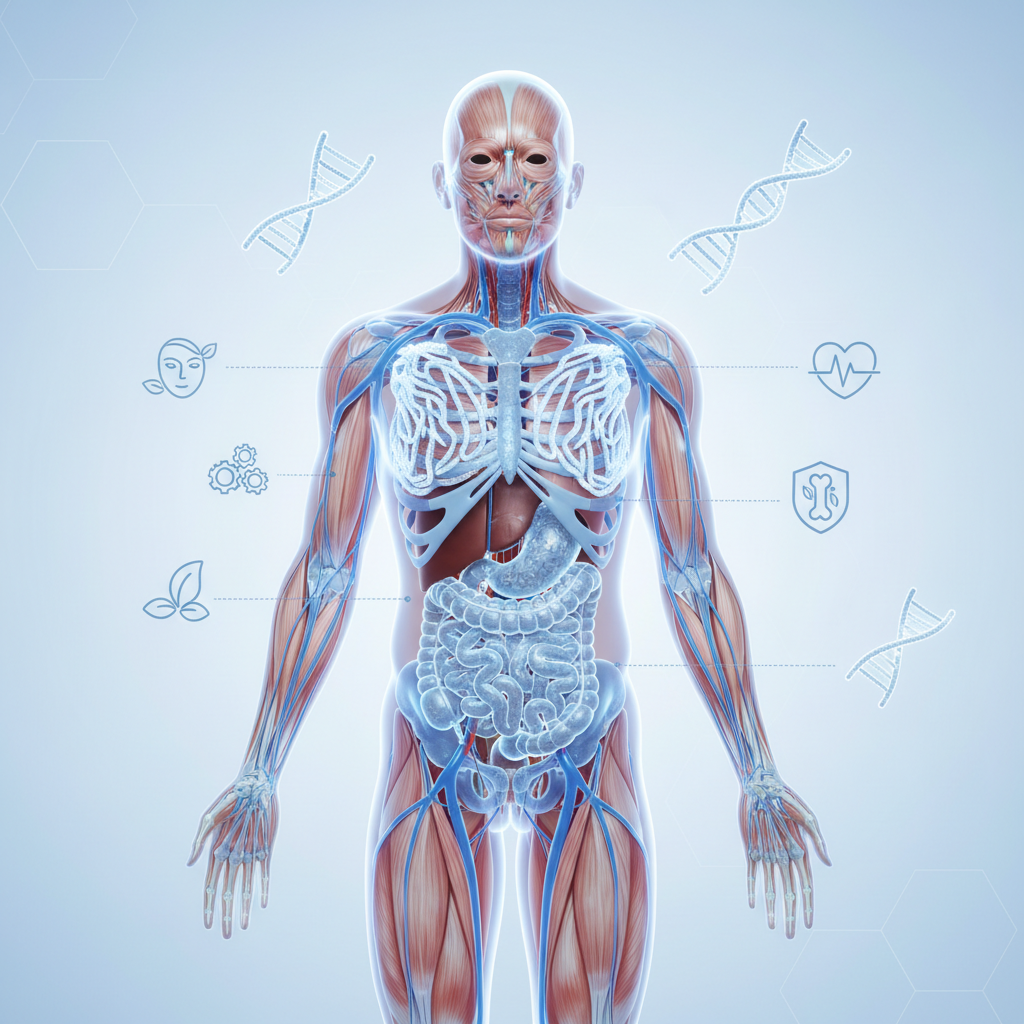
Collagen is on everyone’s lips – literally and figuratively. For a long time, this body’s own structural protein was mainly associated with anti-aging and skincare. But scientific research increasingly shows that collagen is far more than just a beauty supplement. As the most abundant protein in the human body, it plays a central role in numerous bodily functions and our overall health. From stable bones to healthy joints to a functioning digestive system – collagen is an indispensable building block of our organism.
In this article, we examine the diverse functions of collagen in the body, explain why the body’s own production decreases with age, and what health effects supplementation can have. We go beyond the well-known cosmetic effects and show how collagen can holistically support our health.
What Is Collagen and What Function Does It Have in the Body?
Collagen is a fiber-forming structural protein that makes up about 30 percent of the total protein mass in the human body. It forms the basic substance of connective tissue, skin, bones, cartilage, tendons, and ligaments. The main function of collagen is to provide tissues with strength, elasticity, and structure – comparable to a framework that gives our body support.
Scientists have identified 28 different collagen types so far, with types I, II, and III being the most significant. Type I makes up about 90 percent of all collagen in the body and is found primarily in skin, bones, tendons, and ligaments. Type II is mainly present in cartilage tissue, while type III is particularly found in skin, blood vessels, and internal organs.
The body produces collagen itself from amino acids, especially glycine, proline, and hydroxyproline. For this synthesis, it additionally requires vitamin C, zinc, and copper as co-factors. This endogenous production works optimally in young years but decreases continuously from age 25 onwards – by about one percent per year.
Natural Collagen Breakdown: Why Does Our Body Lose Collagen?
Age-related collagen breakdown is a natural biological process influenced by various factors. From the mid-twenties onwards, the body produces less new collagen, while simultaneously the breakdown of existing collagen structures increases. This process is accelerated by several factors:
Oxidative stress from free radicals damages collagen fibers and impairs new formation. UV radiation is one of the main culprits here, which is why excessive sun exposure significantly accelerates the skin aging process. Smoking and alcohol consumption additionally intensify this oxidative stress.
Hormonal changes also play a significant role. Particularly in women, the decline in estrogen levels during menopause leads to accelerated collagen loss – in the first five years after menopause, the collagen content of the skin can decrease by up to 30 percent.
Dietary habits significantly influence collagen production. A sugar-rich diet leads to glycation, a process in which sugar molecules bind to collagen fibers and harden them. A deficiency in vitamin C, zinc, or high-quality proteins can also impair the body’s own collagen synthesis.
Collagen for Healthy Joints and Strong Bones
One of the most important health aspects of collagen concerns the musculoskeletal system. Collagen forms the main component of cartilage tissue, which protects our joints and ensures smooth movement. With increasing age and decreasing collagen content, the risk of degenerative joint diseases such as osteoarthritis increases.
Scientific Findings on Joint Health
Several clinical studies have investigated how collagen supplementation affects joint health. A meta-analysis from 2019 showed that taking collagen hydrolysate over a period of three to six months led to a significant reduction in joint pain in people with osteoarthritis.
Particularly interesting are results concerning physically active people: studies with athletes showed that daily intake of 10 grams of collagen peptides over 24 weeks could significantly reduce joint pain during activity and at rest. The mechanism behind this: the ingested collagen accumulates in cartilage tissue and stimulates the body’s own cells to form new cartilage matrix.
Bone Health and Osteoporosis Prevention
Bones consist of about 90 percent collagen type I, which gives them flexibility and resilience. While calcium is responsible for mineralization, collagen provides the necessary elasticity – an optimal interaction of both components is crucial for stable bones.
Studies on bone density have shown that postmenopausal women who took 5 grams of collagen peptides daily showed a significant increase in bone mineral density after twelve months compared to the placebo group. At the same time, elevated markers for bone formation and reduced markers for bone breakdown were observed.
Gut Health: Collagen and the Intestinal Barrier
A less well-known but increasingly researched aspect is the importance of collagen for gut health. The intestinal wall consists of several layers, with the innermost mucosal layer fulfilling an important barrier function. Collagen is an essential component of this barrier.
In conditions such as leaky gut syndrome, this barrier function is disrupted. Collagen, especially the amino acid glutamine produced during collagen formation, can contribute to the regeneration and strengthening of the intestinal mucosa. The amino acid glycine contained in collagen also has anti-inflammatory effects and can regulate stomach acid production.
Nutrition experts therefore increasingly recommend collagen-rich bone broths or collagen supplements to support gut health, especially with inflammatory bowel diseases or after antibiotic treatment.
Cardiovascular Health: Collagen for Elastic Vessels
Arterial walls contain considerable amounts of collagen, which gives them structure and elasticity. With increasing age and declining collagen content, arteries become stiffer, which can lead to elevated blood pressure and an increased risk of cardiovascular diseases.
A Japanese study from 2017 investigated the effects of collagen peptides on healthy adults with increased atherosclerosis risk. After six months of daily intake, a significant improvement in the atherosclerosis marker was observed, as well as an increase in HDL cholesterol (the “good” cholesterol).
Collagen also supports the integrity of the inner vessel walls (endothelium) and can thus contribute to the prevention of atherosclerosis. However, research in this area is still in its early stages, and further long-term studies are necessary.
Muscle Building and Body Composition
Although collagen does not contain all essential amino acids in optimal composition for muscle building, it still plays an important role in muscle function. About 10 percent of muscle tissue consists of collagen, which supports structure and force transmission.
A study with older men with sarcopenia (muscle wasting) showed that the combination of strength training and collagen supplementation (15 grams daily) led to a greater increase in muscle mass and strength than training alone. The researchers suspect that collagen strengthens the connective tissue structures in the muscle and thus improves training adaptation.
For athletes, collagen can also support the regeneration of tendons and ligaments, which can reduce the risk of injury and accelerate recovery after exertion.
Collagen Supplementation: Forms and Bioavailability
Those who want to supplement collagen face a variety of products. The most common forms are collagen hydrolysate (also called collagen peptides), undenatured collagen, and gelatin.
Collagen Hydrolysate and Collagen Peptides
This form is enzymatically broken down and consists of short amino acid chains that can be particularly well absorbed by the body. The bioavailability is over 90 percent. Studies show that these peptides are detectable in the bloodstream and are specifically incorporated into connective tissue. Collagen peptides dissolve well in cold and warm liquids and are tasteless.
Undenatured Collagen Type II
This form is not broken down and works differently than hydrolyzed collagen. It is taken in significantly lower doses (usually 40 mg daily) and is supposed to work through an immunomodulating mechanism that can be particularly helpful for joint problems.
Origin: Marine vs. Bovine
Collagen can be derived from cattle (bovine), fish (marine), or poultry. Marine collagen consists mainly of type I and has particularly high bioavailability. Bovine collagen contains types I and III and is usually more cost-effective. Regarding effectiveness, the differences are minimal according to current research – the choice depends more on personal preferences and ethical considerations.
Dosage and Intake Recommendations
The optimal dosage depends on the purpose of use. For skin health, studies usually use 2.5 to 5 grams daily. For joint and bone health, effects are seen from 5 to 10 grams daily. Athletes often take 10 to 15 grams to support recovery.
Intake can occur at any time of day, although some experts recommend taking it on an empty stomach for optimal absorption. The combination with vitamin C additionally improves the body’s own collagen synthesis. Regular intake over at least 8 to 12 weeks is important, as building collagen structures takes time.
Natural Collagen Sources in the Diet
In addition to supplements, collagen can also be obtained through diet. Traditional collagen-rich foods are bone broth, which is obtained by long cooking of bones and connective tissue. Gelatin, such as in homemade jelly, also contains collagen.
Meat with connective tissue, poultry skin, and fish with skin are also natural collagen sources. However, collagen intake through diet is usually significantly lower than through concentrated supplements.
Additionally, it makes sense to support the body’s own collagen production through a nutrient-rich diet: Vitamin C (citrus fruits, peppers, broccoli), zinc (pumpkin seeds, nuts, legumes), copper (organ meats, nuts), and silicon (oats, millet) are important co-factors of collagen synthesis.
Side Effects and Safety
Collagen supplements are generally considered very safe and well-tolerated. Side effects are rare and usually mild, such as a feeling of fullness or slight digestive discomfort, which typically subside after a few days.
People with fish allergies should avoid marine collagen, while bovine products are unsuitable for those with beef protein allergies. Pregnant and breastfeeding women should consult their doctor before taking it, as the study situation for these groups is limited.
It is important to choose high-quality products from reputable manufacturers, ideally with test certificates and transparent origin information. Products should be free from heavy metals and other contaminants.
Conclusion: Collagen as a Holistic Health Factor
Collagen is far more than a beauty trend – it is a fundamental structural protein with diverse functions for our health. The scientifically proven effects range from supporting healthy joints and strong bones to promoting gut health and maintaining elastic blood vessels.
The age-related decline in the body’s own collagen production from the mid-twenties makes conscious support through diet or supplementation sensible. Studies show that regular collagen supplementation over several months can have measurable positive effects on various bodily functions.
Nevertheless, collagen should not be viewed as a miracle cure. It unfolds its effects best as part of a healthy lifestyle with balanced nutrition, regular exercise, adequate sleep, and stress management. The combination of endogenous production through optimal nutrient supply and targeted supplementation offers the most holistic approach.
Those considering collagen supplementation should choose high-quality products, pay attention to the correct dosage, and be patient – the building effects only become apparent after several weeks of continuous intake. In case of existing illnesses or uncertainties, consultation with a doctor or nutritionist is advisable.
Research on collagen is constantly evolving and increasingly provides evidence of its importance beyond skin health. Collagen therefore deserves to be recognized as an important building block for holistic health and well-being.
Dieser Ratgeber dient ausschließlich zu Informationszwecken und ersetzt keine medizinische Beratung oder Diagnose. Bei anhaltenden Beschwerden konsultieren Sie bitte einen Arzt. Nahrungsergänzungsmittel und Heilpflanzen sollten nicht ohne Rücksprache mit einem Therapeuten eingenommen werden.