
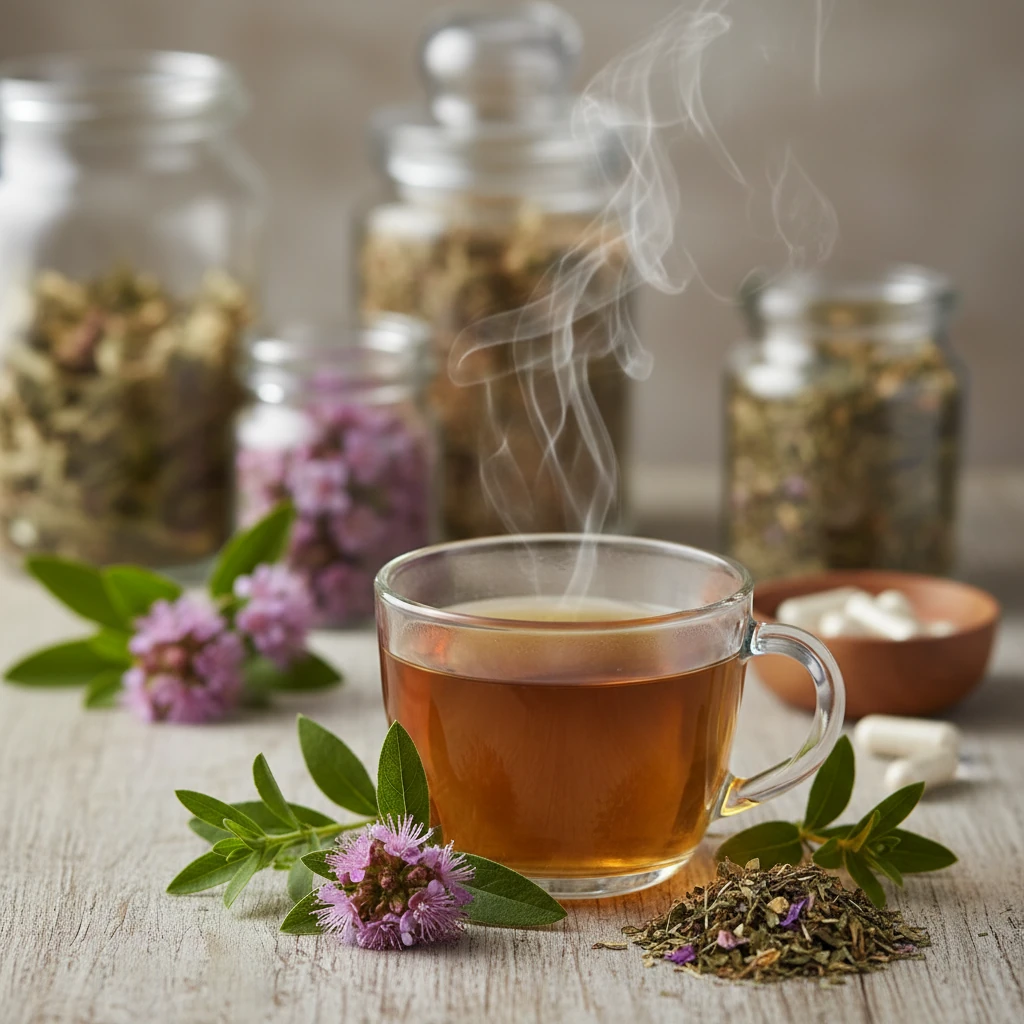
The grey-haired rockrose, botanically called Cistus incanus, is a Mediterranean plant with interesting properties. It has been used in folk medicine for centuries, and modern scientific research is exploring its potential. Particularly its possible antiviral effect and its ability to act as an antioxidant make Cistus incanus an interesting natural approach for your health. In this article, you’ll learn everything important about the rockrose, how it works, and how you can use it.
What is Cistus incanus?
Cistus incanus, also known as grey-haired rockrose, belongs to the family of rockrose plants and is native to the Mediterranean region. The plant grows preferably in the mountainous regions of Greece, particularly on the Chalkidiki peninsula. There it thrives under intense sun exposure and develops its characteristic constituents as a natural protective mechanism against UV radiation and oxidative stress.
The perennial plant reaches a height of about 30 to 100 centimeters and bears pink to purple flowers in early summer. Its leaves are grey-green and covered with fine hairs, which has earned it the German name “grey-haired rockrose.” The leaves and young shoots, which have a high polyphenol content, are mainly used.
The constituents of the rockrose
The health-interesting properties of Cistus incanus lie in its composition of bioactive substances. The plant contains a high concentration of polyphenols – secondary plant compounds that belong to the natural antioxidants.
Polyphenols as the main active ingredient
The polyphenols in Cistus incanus are known for their antioxidant effect. These plant compounds can neutralize free radicals and protect your cells from oxidative stress. Cistus incanus has a high polyphenol content. The most important polyphenols include flavonoids, catechins, and tannins, which work together.
Other constituents
In addition to polyphenols, the rockrose also contains essential oils, resins, and various organic acids. The tannins contribute to the astringent effect, while the essential oils may have antimicrobial properties.
Cistus incanus and viruses: possible natural protection
An interesting property of Cistus incanus is its possible antiviral effect. Various laboratory studies have shown that extracts of the rockrose can inhibit the reproduction of various viruses under certain conditions.
Mechanism of action
The possible antiviral effect of Cistus incanus is based on a special mechanism: In laboratory tests, the polyphenols of the plant can attach to the surface of viruses and essentially “coat” them. This prevents the viruses from docking onto body cells in these studies. This process is called virus blockade.
Laboratory studies showed that Cistus incanus can be effective against various types of viruses such as influenza viruses. The plant could exert its effect already in the mouth and throat area, i.e., where viruses typically enter your body.
Study situation on antiviral effect
Various studies have scientifically investigated the antiviral effect of Cistus incanus. In laboratory studies, including at the Friedrich Schiller University Jena, it was demonstrated that Cistus extracts can inhibit the reproduction of influenza viruses. Some clinical studies showed possible positive effects for colds and flu-like infections, although the study situation is still limited and further research is necessary.
It is important to emphasize that Cistus incanus is not a medicine and cannot replace a healthy lifestyle or medical treatments. However, it can serve as natural support and possibly contribute to strengthening your defenses.
Protection against free radicals: antioxidant effect
Free radicals are reactive oxygen molecules that arise in your body through various processes – whether through metabolic processes, UV radiation, stress, or environmental toxins. These unstable molecules can damage your cells and are associated with premature aging and various diseases. This is where the antioxidant effect of Cistus incanus comes into play.
How antioxidants work
The polyphenols contained in Cistus incanus function as antioxidants. They are able to capture and neutralize free radicals before they can damage your cells. This process is called the “radical scavenger effect.” By supplying antioxidants, you can support your body in maintaining a healthy balance between free radicals and protective substances.
Antioxidant capacity
The antioxidant capacity of plants is often measured using the so-called ORAC value (Oxygen Radical Absorbance Capacity). Cistus incanus has a high ORAC value, which is higher than that of many other antioxidant sources. This makes the rockrose one of the most interesting plant-based antioxidants.
Other possible health benefits of Cistus incanus
In addition to the antiviral and antioxidant effects, Cistus incanus is attributed with other properties that may be interesting for you.
Support for oral health
The antibacterial properties of the rockrose can also be helpful for oral hygiene. Cistus tea or extracts can be used as a natural mouthwash and may help reduce bacteria in the oral cavity. This could contribute to the prevention of gum inflammation, bad breath, and cavities.
Skin health
The antioxidant and possibly anti-inflammatory properties of Cistus incanus also make it interesting for external application. Skin irritations, small wounds, or blemishes could benefit from the properties. Some skincare products already use Cistus extracts.
Anti-inflammatory effect
The polyphenols contained in Cistus incanus possess anti-inflammatory properties in laboratory experiments. They could help influence inflammatory processes in your body.
Application and dosage of Cistus incanus
Cistus incanus is available in various forms, so you can choose the variant that suits you best.
Cistus tea
The most traditional and popular form of application is tea. For one cup, pour hot water (not boiling, about 80–90 °C) over about one teaspoon of dried Cistus leaves and let the tea steep for 5 to 10 minutes. Two to three cups daily are common, especially during cold season. The taste is slightly tart and aromatic.
Capsules and tablets
If you don’t like the taste of the tea or prefer a precise dosage, Cistus capsules or tablets are a practical alternative. Dosage recommendations vary depending on the product and should be followed according to the manufacturer’s instructions. Look for high-quality extracts with standardized polyphenol content.
Lozenges and throat drops
For local application in the mouth and throat area, Cistus lozenges are suitable. They allow longer contact of the active ingredients with the mucous membranes.
External application
For skin care, you can use concentrated Cistus tea as a compress or poultice. Creams and ointments with Cistus extract are also available commercially.
What to look for when buying
The quality of Cistus products can vary. For good quality, you should pay attention to the following criteria:
Choose organic quality from controlled cultivation if possible, ideally from the traditional cultivation areas in Greece. The variety Cistus incanus subsp. tauricus or Cistus incanus subsp. incanus is used. Pay attention to information about polyphenol content. Avoid products with unnecessary additives or fillers.
Possible side effects and contraindications
Cistus incanus is generally considered well tolerated. However, there are some points you should consider.
In sensitive individuals, mild stomach discomfort may occur in rare cases, especially at high doses on an empty stomach. In this case, it is recommended to take it with meals. Allergic reactions to Cistus incanus are very rare, but if you have known allergies to plants from the rockrose family, you should be cautious.
Pregnant and breastfeeding women should consult their doctor before taking Cistus preparations, as there are not yet sufficient studies on this. The same applies if you regularly take medications to rule out possible interactions.
Integration into your daily life
To benefit from the properties of Cistus incanus, you can easily integrate the plant into your daily routine. For example, replace one of your daily cups of coffee or black tea with Cistus tea. Especially during cold season from autumn to spring, a cup of Cistus tea can be a soothing addition.
You can also use Cistus when many people around you have colds or when you have a lot of stress and your immune system could use additional support. Some people also use Cistus tea as a source of antioxidants for their general well-being.
Conclusion: Cistus incanus as a natural supplement
Cistus incanus is an interesting medicinal plant with antioxidant effects and possible antiviral properties. Scientific research is increasingly investigating what traditional medicine has been using for centuries: The grey-haired rockrose can make a contribution to your health.
Especially in times of increased risk of infection, Cistus incanus can be a natural supplement. The high concentration of polyphenols also makes the plant an interesting protection against free radicals and oxidative stress.
However, it is important to have realistic expectations: Cistus incanus is not a substitute for a healthy lifestyle, balanced diet, sufficient sleep, and exercise. But it can contribute as a natural supplement to promoting your health and supporting your well-being.
If you want to try Cistus incanus, it’s best to start with one cup of tea daily and observe how your body reacts to it. With regular use and good quality products, you can benefit from the properties of this Mediterranean plant.
Dieser Ratgeber dient ausschließlich zu Informationszwecken und ersetzt keine medizinische Beratung oder Diagnose. Bei anhaltenden Beschwerden konsultieren Sie bitte einen Arzt. Nahrungsergänzungsmittel und Heilpflanzen sollten nicht ohne Rücksprache mit einem Therapeuten eingenommen werden.