
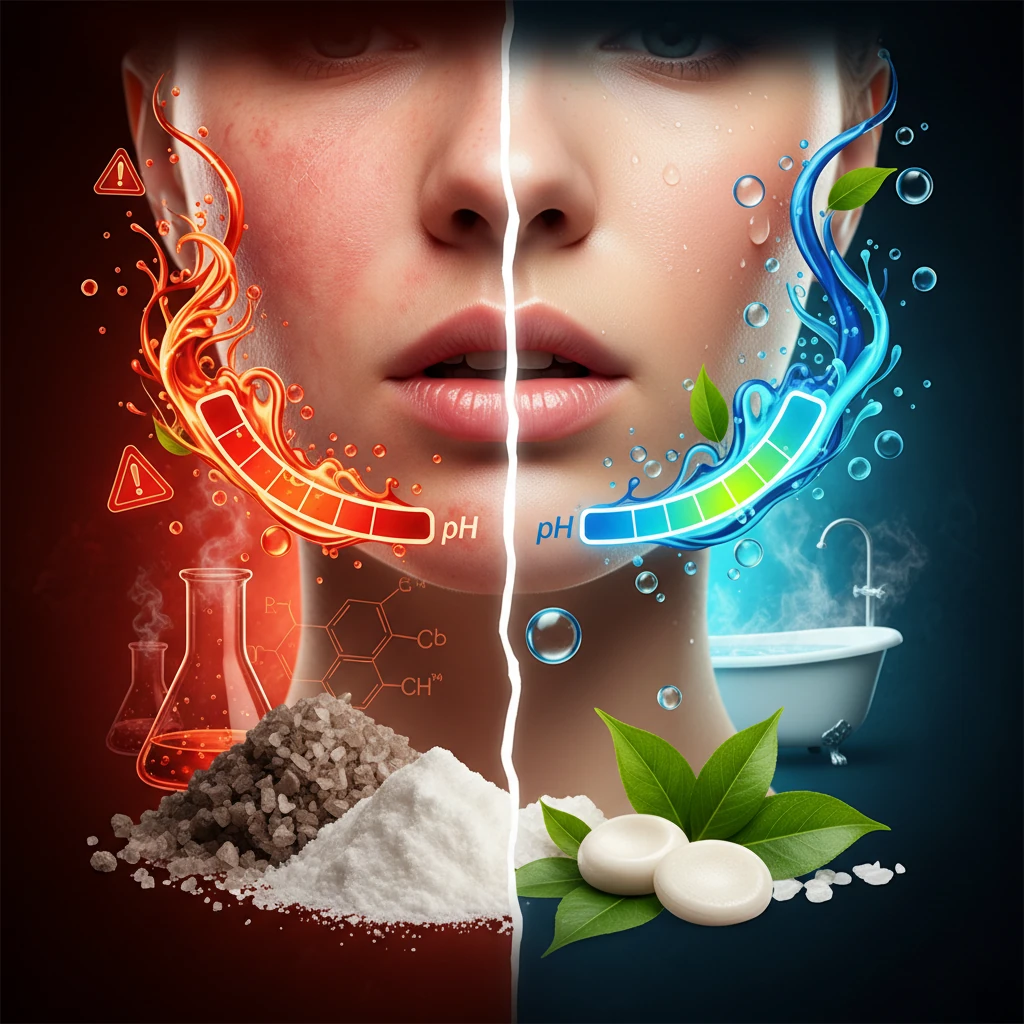
Your skin is a true marvel of nature – it protects you daily from countless environmental influences, regulates your body temperature, and acts as an important barrier against pathogens. For it to perform these tasks optimally, a balanced pH value is crucial. In recent years, alkaline body care has established itself as a popular approach to support skin health. But what’s really behind it? In this article, you’ll learn everything important about your skin’s pH value and how alkaline body care is applied.
What does pH value mean and why is it important for your skin?
The pH value is a measure of the acid or base content of a substance and ranges on a scale from 0 to 14. A pH value of 7 is considered neutral, values below as acidic, and values above as alkaline or basic. Healthy skin has a slightly acidic pH value between 4.7 and 5.75 – this is also referred to as the acid mantle.
This acid mantle is of enormous importance for your skin health. It forms a natural barrier against harmful bacteria, fungi, and other microorganisms, which have difficulty multiplying in a slightly acidic environment. At the same time, it supports the activity of important skin enzymes and keeps the skin flora in balance. When this pH value becomes unbalanced, it can lead to various skin problems – from dryness and irritation to blemished skin and eczema.
Causes of disrupted pH balance of the skin
Various factors can throw your skin’s natural pH value out of balance. The most common causes include:
Conventional care products
Many conventional soaps and cleansing products have an alkaline pH value between 8 and 11. These not only remove dirt and excess oil, but can also impair the natural acid mantle. With regular use, the regeneration of the skin barrier can be hindered.
Environmental influences and lifestyle habits
External factors also play an important role: chlorinated tap water, UV radiation, air pollution, stress, and an unbalanced diet can influence your skin’s pH value. Sweating during exercise can also lead to temporary changes.
Aging processes
With increasing age, your skin’s pH value also changes. The natural regulation mechanisms can decline, which can make the skin more susceptible to external influences.
The concept of alkaline body care
Alkaline body care may sound paradoxical at first – after all, healthy skin is slightly acidic. But the concept is based on a different approach: it’s not about keeping the skin permanently alkaline, but stimulating it toward self-regulation through targeted alkaline applications.
The idea behind it is that alkaline care products with a pH value between 7.5 and 9 temporarily put the skin into an alkaline state. This is intended to stimulate natural regeneration processes and promote circulation. After alkaline application, healthy skin usually regulates its pH value back to the optimal slightly acidic value on its own within 30 minutes to a few hours.
Possible benefits of alkaline body care
Improvement of skin feel
Many users report a softer, smoother skin feel after alkaline applications. The skin can appear smoother. For some people, skin blemishes or dryness can also decrease – however, the effect varies greatly from individual to individual.
Promotion of circulation
Alkaline products can stimulate microcirculation in the skin. This can improve the nutrient supply to skin cells and support natural regeneration processes. Well-circulated skin often looks fresher.
Relaxation and well-being
Alkaline baths in particular have a relaxing effect. The warm water in combination with the alkaline additives can release tension, relax the muscles, and contribute to general well-being.
Practical application of alkaline body care
Alkaline baths
The alkaline full bath is the best-known form of alkaline body care. For optimal results, you should note the following points: Fill your bathtub with body-temperature water (about 36–37 degrees Celsius) and add alkaline bath salt or alkaline powder. The dosage depends on the manufacturer’s instructions; usually about 2–3 tablespoons are recommended for a full bath.
Proponents recommend a bathing duration of at least 30 to 45 minutes, some even 60 to 90 minutes. Gently massage your skin during the bath with a loofah sponge or soft brush – this can enhance the exfoliating effect and circulation.
Alkaline foot baths
If you have little time or don’t want to take a full bath, alkaline foot baths are an alternative. An alkaline foot bath should last at least 30 minutes and can be done several times a week – for example, in the evening while watching TV or reading.
Alkaline body lotions and creams
For daily care, there are alkaline body lotions and creams that have a pH value between 7 and 8.5. These can be applied after showering or bathing. They are particularly intended for people with sensitive or dry-prone skin.
Alkaline facial care
There are also alkaline products for facial care. Alkaline face masks or gentle alkaline cleansing products can be used once or twice a week. Make sure that after alkaline facial cleansing you use pH-neutral or slightly acidic care to soothe the skin.
What you should pay attention to with alkaline body care
Quality of products
Not all alkaline products are the same. Pay attention to high-quality ingredients and natural compositions. Mineral bases such as sodium bicarbonate (baking soda), magnesium carbonate, or calcium carbonate are proven basic substances. Avoid products with aggressive surfactants, synthetic fragrances, or other potentially irritating additives.
Individual skin needs
Alkaline body care is not equally suitable for everyone. People with very sensitive skin, skin conditions such as neurodermatitis or psoriasis should consult a dermatologist before use. In case of acute skin problems or open wounds, alkaline applications are not recommended.
The right frequency
More is not always better. One to two alkaline full baths per week are sufficient for most people. Foot baths can be done more frequently. It’s important that you give your skin time between alkaline applications to regenerate and regulate its pH value on its own.
Combination with conventional care
Alkaline body care should be understood as a supplement, not as a complete replacement for your usual care routine. After alkaline applications, you can and should supply your skin with pH-neutral or slightly acidic care products to strengthen the skin barrier and provide moisture.
Scientific perspective and critical examination
From a scientific perspective, there are both proponents and critics of alkaline body care. The fact is: healthy skin has effective mechanisms for self-regulation of pH value. This so-called acid buffer capacity enables the skin to return to its optimal pH value relatively quickly after alkaline applications.
Studies show that short-term alkaline applications on healthy skin are generally harmless and do not damage the skin, as long as they are not carried out too frequently or too aggressively. The positive effect on subjective well-being and skin feel is reported by many users, although some of the claimed effects are not yet sufficiently scientifically proven.
The sometimes exaggerated emphasis on “over-acidification” of the body should be viewed critically. The human organism regulates its acid-base balance very precisely through various buffer systems, the lungs, and the kidneys. True acidosis is a medical emergency and is not caused by wrong diet or care products. The skin plays only a subordinate role in the body’s de-acidification – mainly the kidneys, lungs, and liver are responsible for this.
Making alkaline body care yourself
If you want to try alkaline body care, you don’t necessarily have to buy expensive products. Simple home remedies can already be used:
For an alkaline bath, you can use 2–3 tablespoons of baking soda (sodium bicarbonate), which you can get at any drugstore or pharmacy. A combination of baking soda and sea salt in a 2:1 ratio is also suitable. For a foot bath, 1–2 tablespoons in about 5 liters of warm water are sufficient.
An alkaline face mask can be made from healing clay and a little baking soda. Mix the ingredients with water to a creamy paste, apply it to cleansed facial skin, and let it work for 10–15 minutes before rinsing it off with lukewarm water.
Conclusion: Balance is the key
Alkaline body care can be a complement to your care routine if you apply it correctly. It can contribute to a pleasant skin feel and promote relaxation. The key lies in balanced application and consideration of your individual skin needs.
It’s important to understand that alkaline care is not a miracle cure and cannot replace a healthy lifestyle. A balanced diet, sufficient fluid intake, enough sleep, and stress management are just as important for healthy skin as proper care from the outside.
Listen to your skin’s signals and ease into alkaline applications slowly. Start with an alkaline foot bath or a short full bath and observe how your skin reacts. With positive experiences, you can gradually expand the applications. Should you notice skin irritations, reduce the frequency or temporarily avoid alkaline products.
Ultimately, it’s about finding a healthy balance – both in caring for your skin and in your overall lifestyle. Alkaline body care can be one building block that can contribute to greater well-being.
Dieser Ratgeber dient ausschließlich zu Informationszwecken und ersetzt keine medizinische Beratung oder Diagnose. Bei anhaltenden Beschwerden konsultieren Sie bitte einen Arzt. Nahrungsergänzungsmittel und Heilpflanzen sollten nicht ohne Rücksprache mit einem Therapeuten eingenommen werden.